



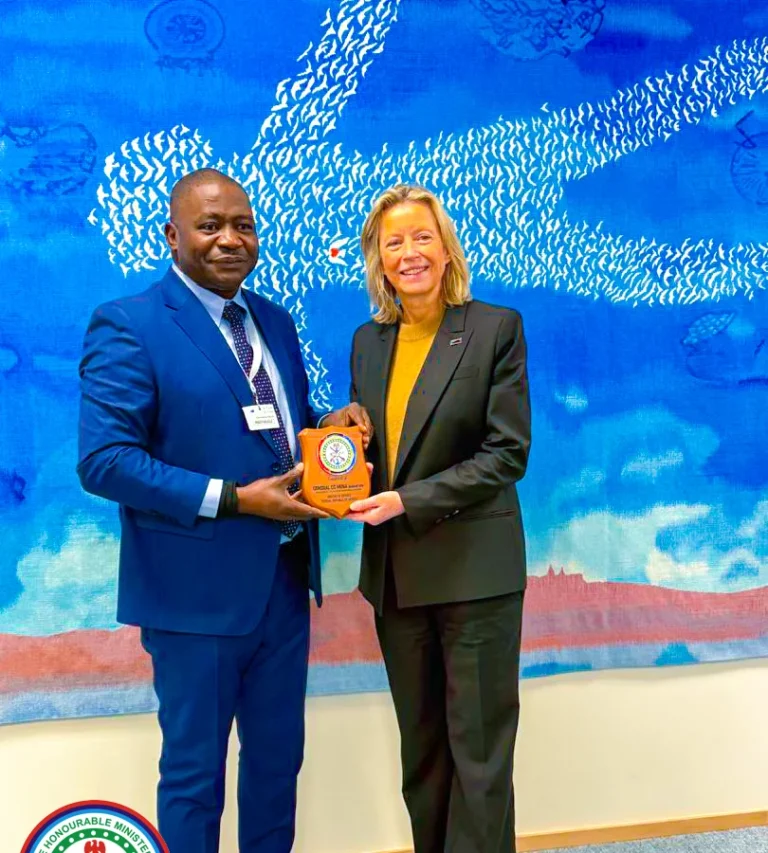
Nigeria’s Minister of Defence Christopher Musa has reiterated the commitment of the Nigerian government to a comprehensive, multi-dimensional strategy to counter terrorism.
Musa said at the third edition of the Schuman Security and Defence Forum held at the European Parliament in Brussels, Belgium that terrorism was a complex security challenge that exploited economic vulnerabilities, porous borders, local grievances and transnational organised crime.
According to the statement by the Special Assistant on Media to the Minister, Mrs. Leah Katung-Babatunde, the minister stated that with Nigeria’s National Counter Terrorism Strategy (NACTEST), the nation had transitioned from a predominantly kinetic approach to a coordinated framework.
According to Musa, this integrates military operations, intelligence, law enforcement, community engagement and socio-economic interventions under the leadership of President Bola Tinubu.
Addressing the evolving tactics of violent extremist groups, Musa said that Nigeria had taken proactive measures to counter illicit use of drones, digital communications and satellite technologies.
The Nigerian minister said that through intelligence-led operations, advanced surveillance, unmanned aerial platforms and military artificial intelligence, the Armed Forces of Nigeria continued to degrade terrorist capabilities.
He disclosed that in May 2026, troops of Operation HADIN KAI successfully intercepted over 400 Starlink communication devices linked to terrorist networks in the North East of Nigeria.
He disclosed that beyond operational interceptions, the ministry was driving indigenous defence innovation through research and private-sector partnerships, while seeking deeper collaboration with the EU in counter-drone technologies, digital forensics and satellite intelligence.
Musa emphasised that lasting peace required dismantling criminal economies that finance insurgency, including kidnapping for ransom, illegal mining, cattle rustling and illicit arms trafficking.
He said that the Nigerian Financial Intelligence Unit (NFIU), the National Counter Terrorism Centre (NCTC) and security agencies were working in synergy to trace illicit financial flows, prosecute criminal facilitators and secure national borders to choke off terrorist supply chains.
The minister reaffirmed Nigeria’s dedication to collective regional security through the Multinational Joint Task Force (MNJTF) in the Lake Chad Basin, ECOWAS, the African Union and international initiatives such as the West Africa Police Information System (WAPIS).
He assured that the Armed Forces of Nigeria remained strictly bound by national laws and international humanitarian law, prioritising civilian protection, and due process in prosecution of suspects.
GIK/APA