





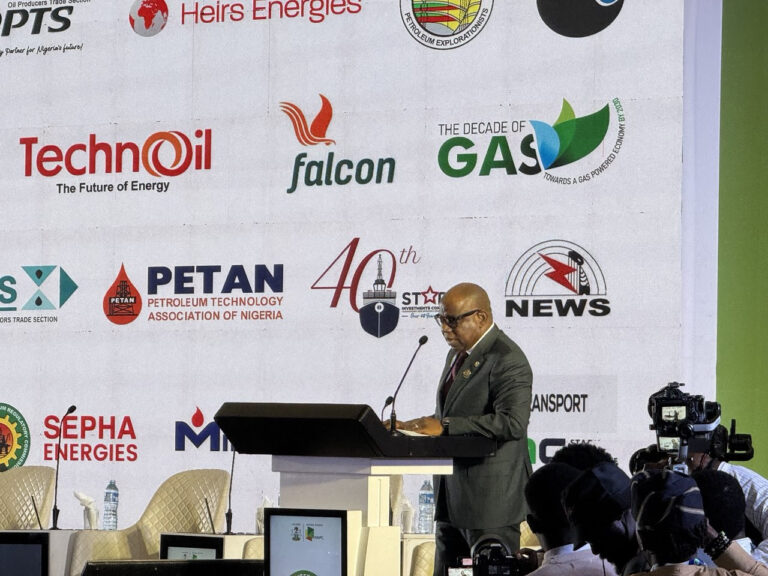
The Nigerian National Petroleum Company Limited (NNPCL) has said that Nigeria is repositioning itself as a dependable global energy supplier, citing improved security, policy stability and renewed investor confidence in the oil and gas sector.
Speaking during a fireside chat at CERAWeek 2026 in Houston in the United States, the Group Chief Executive Officer of the NNPCL, Mr. Bayo Ojulari, said that Nigeria was leveraging a more secure operating environment in the Niger Delta and reforms under the Petroleum Industry Act to rebuild its global energy standing.
Ojulari projected a modest increase in crude output, with production expected to rise by about 100,000 barrels per day in the coming months.
However, this remains below the Nigerian government’s 2026 benchmark of 1.84 million barrels per day.
He attributed recent gains to enhanced operational autonomy granted by President Bola Tinubu, which he noted, has enabled the company to make more commercially driven decisions and improve efficiency.
According to local media reports, Ojulari disclosed that about 100 per cent pipeline availability has been achieved over the past year through strengthened collaboration between security agencies and host communities, significantly improving operational stability.
He emphasised that disciplined project execution would be critical to sustaining growth, noting that NNPCL is now implementing outcomes from a comprehensive portfolio review completed last year, alongside efforts to deepen partnerships with international oil companies.
Ojulari highlighted renewed investor confidence, pointing to major project commitments and the resolution of longstanding disputes such as the ENI-operated OPL 245.
He also referenced the $20 billion Shell-operated Bonga Southwest project as evidence of growing international trust in Nigerian energy sector.
On domestic energy security, he commended the Dangote Refinery for reducing Nigeria’s exposure to global supply volatility, cutting dependence on imports and providing a stable outlet for locally produced crude oil.
The NNPCL boss also disclosed that the $5 billion NLNG Train 7 project is expected to be commissioned before the end of the year, with plans underway to expand capacity further through additional trains.
He noted that with over 200 trillion cubic feet of proven gas reserves, Nigeria is intensifying efforts to harness its gas potential for both domestic use and export, supported by key infrastructure projects such as the AKK and OB3 pipelines.
Ojulari acknowledged that while Nigeria cannot match the scale of top producers like Saudi Arabia, it remains well-positioned to contribute to easing global supply pressures.
He stressed that the company’s long-term strategy is shifting from resource ownership to resource monetisation, with a focus on unlocking value through efficient project delivery, competitive fiscal frameworks, and stronger partnerships.
CERAWeek 2026, organised by S&P Global, hosted over 10,000 global energy leaders to discuss the intersection of energy, technology and geopolitics.
GIK/APA