



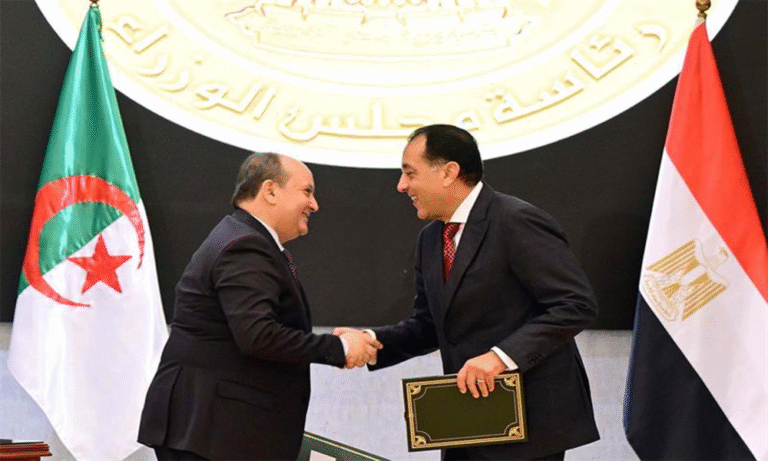
The sun appears to be shining again on Egypt-Algeria economic relations even if old fragilities refuse to go away for the latter.
The outcome of the ninth session of the Egypt–Algeria Joint High Commission, held in Cairo on Wednesday, 26 November 2025, was marked by an unusually high number of memorandums—an abundance that does little to hide Algeria’s underlying structural vulnerabilities.
Numerous agreements were signed on the sidelines of the Joint High Commission, covering sectors as varied as urban development, documentation, youth affairs, consumer protection and trade fairs. According to the official Egyptian communiqué, these documents reflect the two countries’ intention to “strengthen their relations.”
In reality, their sheer number mainly highlights Algiers’ eagerness to project diplomatic momentum at a time when its economic apparatus remains unable to generate credible projects without attaching itself to more structured partners.
Behind the official rhetoric of “complementarity,” Egypt clearly stands out as the driving force in this sequence, assuming its role as a provider of expertise, especially in infrastructure and engineering.
Egyptian Prime Minister Mostafa Madbouly emphasised the creation of joint working groups to monitor the implementation of the memorandums—an insistence that reads like an inadvertent admission: much of the follow-through depends on Egypt’s ability to initiate, supervise and, in many cases, execute. The contrast with Algiers is stark. Algeria’s economic diplomacy continues to struggle to move beyond repeated announcements and broad cooperation pledges that lack solid enforcement mechanisms.
Even the commercial dimension, presented as a top priority, reveals a clear asymmetry. Algeria has floated the idea of increasing bilateral trade from $1 billion to $5 billion, but economic reality tells a different story: the country’s hydrocarbon-dependent industrial structure, with its limited productive base, makes such a leap unrealistic without massive foreign know-how.
The Egypt–Algeria Business Forum, which followed the press conference, risks becoming yet another platform where Algeria seeks external expertise to offset its internal shortcomings.
Parallel meetings dedicated to infrastructure further illustrate this dependency. Egyptian Deputy Prime Minister for Industry and Transport, Kamel Al-Wazir, proposed directing Egyptian companies toward Algerian projects, highlighting their track record in major regional developments.
In response, Algerian ministers Saïd Sayoud and Yahia Bachir had little choice but to agree to a form of cooperation that resembles an outsourcing of competencies more than a balanced partnership.
Lacking a coherent industrial ecosystem, Algeria appears willing to import expertise, project management and, at times, even strategic vision.
MK/ak/sf/lb/as/APA.