



The Church of England says it is prepared to operate a reparative justice fund to rehabilitate African communities affected by the trans-Atlantic slave trade, but controversy has caught up with the issue.
Critics say while the initiative could be a force for good to help millions on the continent, there are inherent inaccuracies which fail to capture the real perspective surrounding the chattel slavery involving Britain which later spent significant resources to end slavery in parts of the world under its control.
The Church of England were seen as a direct participant in the running of Britain’s chattel slavery. Its historical endowment fund covered large investments in the South Sea Company which was involved in the trafficking of slaves from Africa through the course of the 18th century slave trade across the Atlantic.
It’s three years since the church owned up to its role in the phenomenon, a scar blotting the history of its evangelisation around Africa, this coming after it emerged that it had profited from investments which today may be worth billions of dollars stashed into its investment fund.
Since then the general policy of the church has been one of making amends where possible hence the creation of a reparation kitty worth over $135 million under the so-called Project Spire, to fund an investment, research and engagement scheme in communities in Africa found to have been adversely affected by the trade in humans from the 16th to the 19 century during which some 14 million people were captured, shipped and enslaved in the west.
One of the bishops of the church in Manchester wrote ”having come to the full understanding of the extent of the involvement of Queen Anne’s Bounty in investing in the slave trade through research and forensic analysis…we cannot hold on to money gained so wrongly, any more than a burglar can hang on to profits from their activity”.
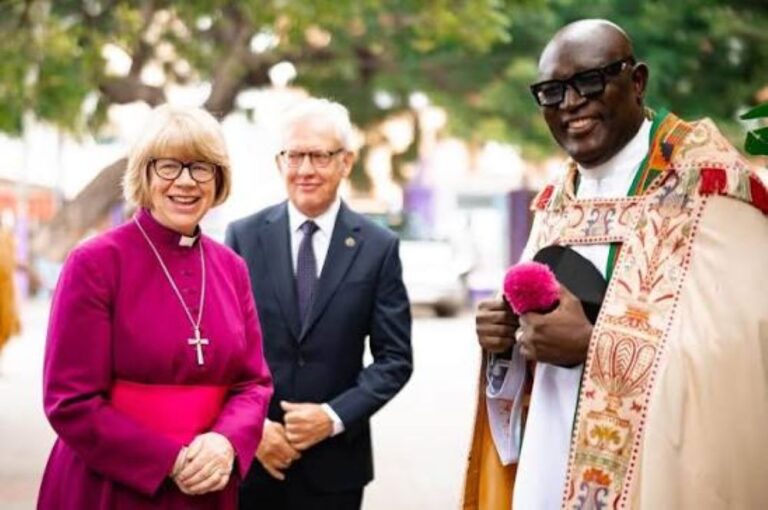
It was in this spirit that recently the new Archbishop of Canterbury Dame Sarah Mullally, who was installed last March spoke about the fund while she was on a trip to Ghana where she toured the Cape Coast Castle, a harnessing point for captured slaves before they were forcibly taken to the Americas.
Acknowledging the role of the Church of England in the enslavement of Africans, the Archbishop said ”part of the Christian belief in repentance is about action, so we are putting in place action to support those communities that feel the legacy of the slave trade”.
However, the church’s commissioned report on its role in the slave trade which revealed ”uncomfortable truths” about its links to one of the most immoral activities in human history had attracted strong criticism.
Critics of this position have been far from silent, arguing that the case for reparations while well intentioned to make amends for the evils of slavery in Africa, grossly overstate the facts which are near-impossible to value in monetary terms. Some critics within the church even question the wisdom in operating such a fund which does not capture the overall picture of the church’s investment. It also disputes the notion that the church had made a deliberate attempt to invest directly in chattel slavery, arguing that this was unsupported by details on ledgers linked to slave trade transactions.
Richard Dale, emeritus professor at the University of Southampton insists that the church’s investment in the South Sea Company was through government bonds instead of directly in its finances.
In one of his writings defending the church’s reputation during the slave trade, Dale argued that its commissioners had relied on distorted history to denounce Church of England officials of the time while vilifying their own church.
”However, this narrative is demonstrably false. The Church Commissioners’ historical advisers have misled the Commissioners, the Commissioners have misled Church leaders and Church leaders have misled the public at large. Because there is incontrovertible evidence that Queen Anne’s Bounty’s investments earned not one penny from the slave trade” he said.
Meanwhile Ghana, one of several African countries whose communities suffered untold consequences from the trans-Atlantic slave trade, recently spearheaded UN resolutions pushing for formal apologies from perpetrators and reparative justice.
While the Ghanaian government welcomed Archbishop of Canterbury Dame Sarah Mullally’s vow to right some of the wrongs of her church, officials in Accra hope this would be more than just words given that perpetrator nations of the slave trade had made similar pronouncements in the past without recourse to tangible action.
WN/as/APA