



Senegal’s 2026 Draft Finance Bill (DFB) sets projected revenues at 6,188.8 billion CFA francs and expenditures at 7,433.9 billion CFA francs, resulting in a budget deficit equivalent to 5.37% of Gross Domestic Product (GDP).
The report from the Senegalese National Assembly’s Finance Committee, presented by General Rapporteur Mady Danfakha, indicates a substantial 23.4% increase in revenues and a 12.4% rise in expenditures compared to the 2025 Initial Budget Law (IBL).
The government has committed to an ambitious fiscal consolidation path aimed at gradually reducing the budget deficit from 12.8% of GDP in 2024 to 7.8% in 2025, then to 5.37% in 2026, and finally to 3% by 2027.
According to Minister of Finance and Budget, Cheikh Diba, the 2026 budget is intended as an instrument for recovery and for restoring confidence following discoveries made during audits of public finances.
The Economic and Social Recovery Plan (ESRP) is expected to contribute 703.6 billion CFA francs to fiscal receipts in 2026, projecting the tax-to-GDP ratio at 23.2%, up from 19.3% a year earlier. Key targeted funding sources include land tenure regularisation, gambling/gaming, mobile money taxation, and increased excise duties on alcohol and tobacco.
Audits conducted by the General Inspectorate of Finance, the Court of Auditors, and the Forvis Mazars firm have reassessed the public debt at approximately 119% of GDP, a figure significantly exceeding the West African Economic and Monetary Union (UEMOA) convergence standard of 70%. Minister Diba estimated that a significant portion of this debt was “hidden,” as it had not been included in previously published official data.
For 2026, total financing needs amount to 6,075.2 billion CFA francs. This sum includes 4,307.4 billion FCFA for debt principal repayment (amortisation) and 1,245.1 billion CFA francs to cover the deficit. Approximately 65% of these needs will be raised on the regional financial market, notably through “diaspora bonds.”
General budget expenditures are fixed at 7,177.2 billion CFA francs, allocated across several categories: debt interest payments (1,190.6 billion), personnel costs (1,532.8 billion), goods and services and transfers (1,650 billion), as well as investments from internal and external resources, totaling approximately 2,804 billion CFA francs.
The 2026 budget is based on an economic growth forecast of 5%, down from 7.8% in 2025, driven by the primary sector (+6.1%), the tertiary sector (+5.4%), and the secondary sector (+2.9%). The GDP deflator is expected to be 2%.
Regarding arrears clearance, 300 billion CFA francs is earmarked in 2026 for the settlement of domestic arrears, following the 500.9 billion CFA francs already mobilised in 2025 to pay supplier debts, particularly in the Construction and Public Works (BTP) and energy sectors.
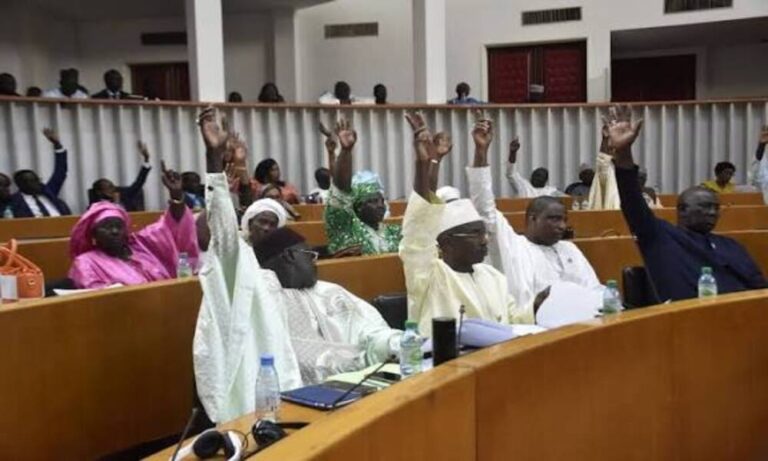
During the parliamentary debates, several lawmakers voiced concerns about the government’s ability to reduce the deficit to 3% of GDP by 2027, the increasing burden of debt service, and the impact of new taxes on already struggling populations.
They also demanded the publication of the complete debt inventory reports, including the one from Forvis Mazars, and advocated for better funding for local authorities and social sectors.
Minister Diba indicated that Senegal is currently negotiating with the International Monetary Fund (IMF) to establish a new program, following the suspension of the previous one after the audit revelations.
An IMF mission recently visited Dakar, and an informal executive board consultation was held to examine the situation. Minister of Economy, Abdourahmane Sarr, stressed that Senegal’s membership in UEMAO facilitates its access to the regional financial market to cover its financing needs.
AC/sf/lb/as/APA