



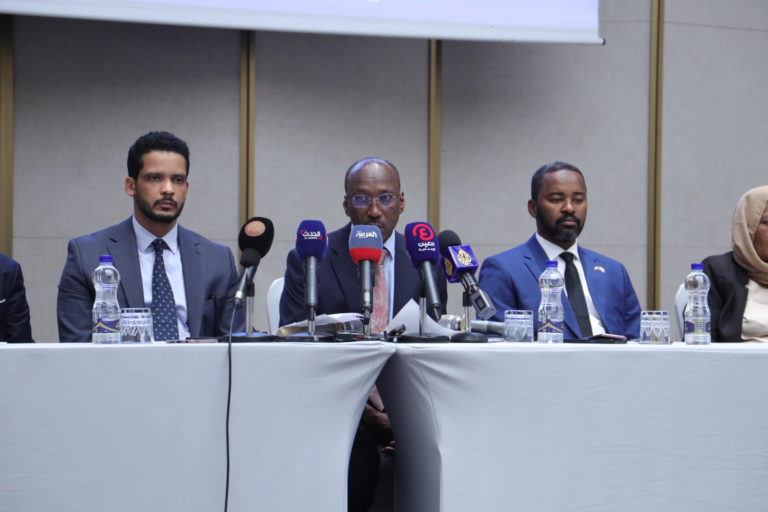
The Sudan Founding Alliance, known as TASIS, said it sees no reason to hold direct or indirect talks with the military junta in Sudan.
The alliance’s statement came during a press conference held on Friday in Addis Ababa, the capital of Ethiopia, prior to the start of the long-awaited consultations on the five-party mechanism to end the crisis in Sudan.
The alliance’s official spokesperson, Ahmed Tagad Lissan said that what is being circulated about communication between the alliance and the Port Sudan authority is “completely unfounded,” adding that the alliance has not held any contacts or meetings outside the framework of international initiatives and mechanisms seeking to establish peace in Sudan.
Taqad stressed that any attempt to exclude or bypass the alliance in any peace process or political dialogue would not yield practical results on the ground and lack the elements of success and sustainability.
Regarding the arrangements for the political process, the spokesperson emphasised that the alliance categorically rejects the participation of the Islamic Movement, the National Congress Party, or any of their political or organisational fronts in any negotiation process or political settlement related to the Sudanese conflict.
The alliance linked its participation in any peace initiative or political process to the statement issued by the what is called “Quartet on Sudan”, which called for a three-month humanitarian truce through the Jeddah platform, as a prelude to reaching a permanent ceasefire and launching a civilian transition process that excludes the warring parties from power.
Taqad called for the immediate commencement of a comprehensive humanitarian truce ahead of any peace talks or political negotiations.
“The priority at this stage should be reaching a temporary ceasefire and creating the necessary humanitarian conditions, paving the way for a comprehensive political process, whether through direct negotiations or Sudanese-Sudanese dialogue,” Taqad told the press conference.
He also defended the idea of forming a parallel government in Sudan, indicating that official recognition of it is not a priority at this stage. He said that the coalition has an extensive network of relationships with a number of countries and regional and international powers, in addition to its communication with institutions of the international system.
Taqad affirmed that the African Union remains the most appropriate platform for sponsoring Sudanese dialogue, provided that the participating parties are selected according to objective criteria that are appropriate to the nature and complexities of the current conflict.
Commenting on the Democratic Bloc’s refusal to engage with the alliance, Taqad said that this stance was of no importance to the alliance, emphasizing that any political party has the right to adopt whatever position it deems appropriate. However, he stressed that any peace process or dialogue that excludes the alliance will be incapable of producing a genuine settlement to the Sudanese crisis.
Following the ousting of long time president Omar al-Bashir in April 2019, Sudan entered a period of political transition which abruptly ended with a further coup by the Sudanese Armed Forces led by Abdel Fattah al-Burhan in October 2021.
A civil-war between the al-Burhan led Sudanese Armed Forces (SAF) and the paramilitary Rapid Support Forces (RSF) led by Mohamed Hamdan Dagalo (Hemedti) broke out in April 2023.
Thousands mostly civilians have been killed and mllions displaced in and out of the country.
MG/as/APA