



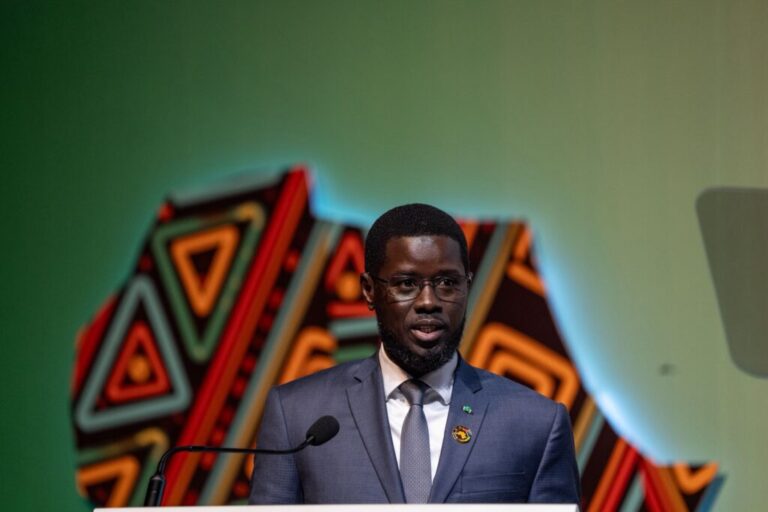
Senegalese President Bassirou Diomaye Faye opened the 10th edition of the Dakar Forum on Peace and Security in Africa in Diamniadio on Monday with a call for a rethinking of Africa’s response to security crises and for a stronger assertion of the continent’s sovereignty.
Speaking before several heads of state and regional officials, Faye welcomed the presence of guest leaders and partners, saying their participation “reflects a shared commitment to peace and security on the continent.” He noted that Dakar has established itself as a “capital of African and international strategic dialogue” on security issues.
The Senegalese president said the world in 2026 is marked by “deep instability,” weakened multilateral consensus and crises with significant effects on regional balances. He pointed to trade tensions between major powers, the resurgence of protectionism, and international conflicts, including the situation in Gaza.
On the African continent, Faye highlighted the growing range of threats, including armed conflicts, terrorism, cross-border crime, maritime piracy, disinformation, cybercrime, as well as the impacts of climate change and health risks.
According to him, these dynamics require a shift in Africa’s responses, as “existing collective security architectures show their limits,” particularly in terms of financing, mandates and operational capacity. He stressed the urgent need to make them “more agile, more effective and better adapted to realities on the ground.”
The Senegalese leader stated that “Africa must no longer be merely a centre of competition among major powers,” calling for the continent to become a full actor in global realignments and to fully assume its sovereignty.
He insisted that Africa’s security priorities should no longer be defined elsewhere, nor its strategic spaces occupied without oversight, advocating sovereignty that is simultaneously strategic, economic and digital.
On the economic front, Faye called for local transformation of African resources, based on the principle of “extract here, transform here, and sell at a fair price,” in order to support industrialisation and value creation on the continent.
Turning to security, he advocated strengthening conflict prevention and early warning mechanisms, operationalising standby regional forces, and improving coordination through clearer mandates and more stable financing under the control of African states.
He also stressed the need for enhanced regional cooperation to counter the expansion of terrorism and for the development of an African defence industry to reduce dependence on external military equipment.
Faye also drew attention to the human dimension of crises, citing children deprived of schooling, women exposed to violence, and young people vulnerable to recruitment by criminal networks.
To address these challenges, he called for greater investment in education, training and digital technology, saying this was “an effective way to combat indoctrination and radicalisation.”
Finally, he reiterated that “peace and security are inseparable from development,” urging deeper continental integration through frameworks such as the African Continental Free Trade Area (AfCFTA) and Agenda 2063, so that Africa can move from vulnerability to economic power.
AC/lb/as/APA