



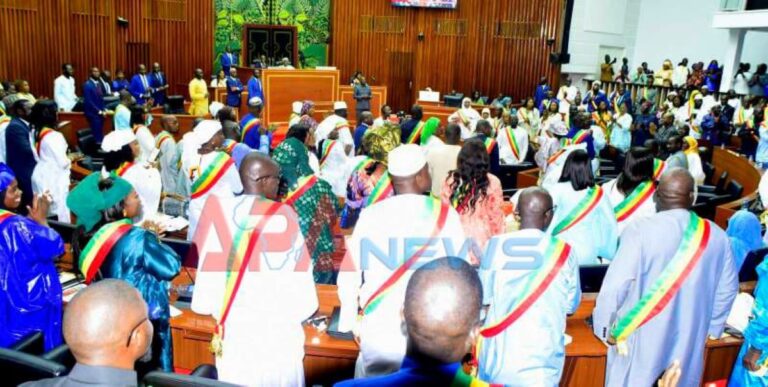
Draft Law No. 40/2026, the supplementary finance bill (LFR) for the year 2026, was rejected by the National Assembly in Senegal during its plenary session.
Of the 132 deputies who participated in Tuesday’s vote, 109 voted in favour of a “prior question” (a procedural motion) introduced by deputy Amadou Ba – a member of the parliamentary majority – while 20 voted against it and three abstained.
This procedure, which exempts the assembly from further deliberation on the text, effectively resulted in its rejection during the plenary session.
The decision follows two consecutive rejections of the bill by the Finance and Budgetary Control Committee on October 23 and 30.
On October 27, the government had successfully requested that the text be sent back to the committee – a move initiated by the Minister of Economy, Finance, and Planning, Cheikh Diba – in order to continue discussions with the deputies. These exchanges, however, failed to produce a compromise.
Submitted to the National Assembly on September 18, the supplementary finance bill adjusts budget revenues to 5,848.7 billion CFA francs – down from the 6,188.8 billion originally projected – and increases expenditures to 7,583.9 billion, up from 7,433.9 billion.
Consequently, the deficit has been revised to 1,735.2 billion CFA francs, or 7.6% of the gross domestic product (GDP), compared to 5.4% in the initial finance law.
The bill notably included a 540.3 billion CFA franc increase in energy subsidies – bringing the total to 790.3 billion – as well as a cut of 555 billion CFA francs in investment appropriations.
The government had urged the adoption of this budgetary revision, arguing that it was necessary to adjust public finances in light of declining revenues and rising priority expenditures.
In a statement issued on October 31, the Ministry of the Economy, Finance, and Planning warned that any prolonged budgetary uncertainty could jeopardize the mobilisation of necessary funding for 2026 and exacerbate strains on the state’s cash flow.
This rejection occurs against a backdrop of limited fiscal space, difficulties in accessing financial markets, and ongoing negotiations with the International Monetary Fund (IMF).
The controversy surrounding the supplementary budget bill (LFR) also unfolds amid a rift between President Bassirou Diomaye Faye and Ousmane Sonko – a former Prime Minister, now National Assembly Speaker.
Following the end of Mr. Sonko’s tenure on May 22, 2026, his party (Pastef,) did not join the new government, despite retaining its parliamentary majority.
Meanwhile, on July 25 in Dakar, President Faye launched a new party, “Kiiraay – Les Patriotes Republicains” (Kiiraay – The Republican Patriots), which emerged from the transformation of
the “Diomaye President” Coalition.
AC/Sf/fss/as/APA