



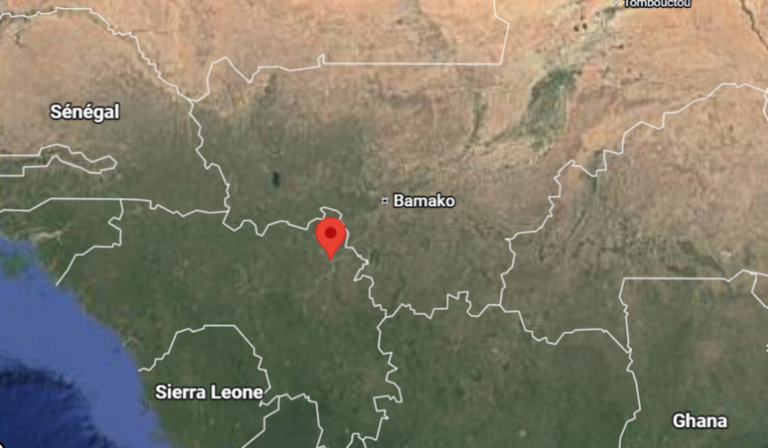
The government of Guinea has announced a total ban on unregulated gold mining in the Siguiri administrative region, in the northeast of the country.
This decision has triggered the departure of foreign workers – including several thousand from Burkina Faso, according to authorities in Ouagadougou.
The Guinean government justified the measure by citing environmental degradation and damage to watercourses, as stated in a joint communiqué released on November 2, 2026, and signed by five members of the executive branch, including the Minister of Mines and Geology, Bouna Sylla.
Authorities report that inspection and assessment missions conducted in recent months have revealed alarming environmental degradation linked to artisanal mining activities that fail to comply with existing regulations.
They point to the destruction of soil, agricultural land, and vegetation cover caused by the use of heavy machinery, as well as the pollution and siltation of the Niger, Djoliba, and Tinkisso Rivers.
The communiqué specifically prohibits the use of dredges, the extraction and washing of ore within riverbeds or along riverbanks, and the use of explosives, mercury, cyanide, and other hazardous chemicals. Mining is also banned in protected areas, classified forests, agricultural land, pastures, and in the vicinity of residential areas and public infrastructure.
To enforce these measures, the authorities have announced the permanent deployment of defence and security forces in the region. Inspections will be carried out along road and river routes, as well
as at entry points to Siguiri, to prevent the transport of equipment and materials intended for illegal mining operations.
The deployed forces will also verify the identities and legal residency status of individuals present at these sites.
Foreign nationals found to be in the country illegally will be subject to the procedures prescribed by law. Furthermore, the government has specified that the buying and selling of gold produced in the region may only be conducted through authorized trading outlets.
This decision has repercussions for foreign nationals working in the region’s artisanal mines. On Tuesday, the Burkinabe government announced measures to organize the return of several thousand of its citizens – who have been expelled from Guinea – in a manner that ensures “dignity and decency.”
A government delegation is set to travel to Mali on Wednesday to provide assistance to Burkinabe nationals in distress, the Burkina Information Agency (AIB) reported, citing a government source.
The route through Malian territory is a result of the overland path being taken for their return from Guinea.
However, Burkinabe authorities have not specified the exact number of affected citizens, nor have they provided detailed arrangements for their repatriation. In light of this situation, the government has called on the public to remain calm and exercise restraint, urging them not to fall prey to manipulation or disinformation.
According to the AIB, the expulsions involve Burkinabe citizens who were engaged in activities at artisanal mining sites in Guinea.
In its statement, the Guinean government asserts that these operations do not call into question the importance of the gold sector to the national economy; rather, they are intended to protect the population, preserve the environment, and ensure that mining activities comply with the law and the principles of sustainable development.
In an interview regarding the launch of the Nimba Gold Refinery, the Minister of Mines and Geology, Bouna Sylla, advocated for the cleanup of the gold sector – an initiative aimed at putting an end to illegal production, the pollution of waterways, and practices that operate outside of state oversight.
He also noted that in 2024, Guinea produced 72 tonnes of gold, 70% of which came from artisanal mining. The government intends to gradually expand semi-industrial and industrial operations, with semi-industrial mining now reserved exclusively for domestic operators.
AC/fss/as/APA