





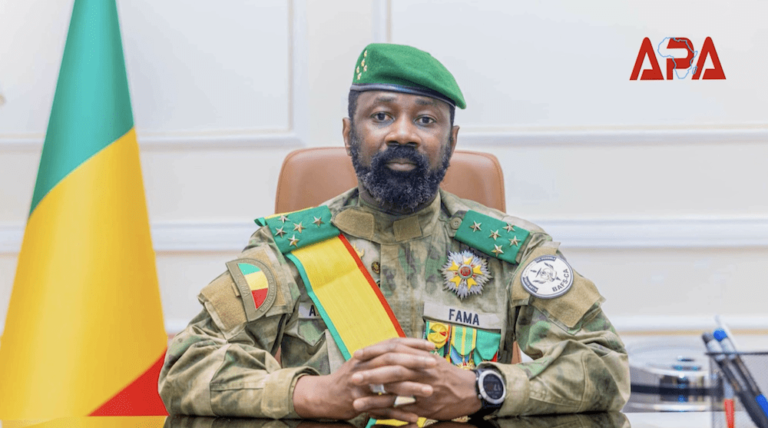
Six years after the 18 August 2020 military coup that ousted President Ibrahim Boubacar Keïta, Mali remains under military governance in a transition that has fundamentally reshaped the geopolitical, security, and diplomatic landscape of the Sahel region.
What was originally introduced as a brief 18-month interim period led to an initial leadership change under Bah N’Daw before Colonel Assimi Goïta consolidated power in May 2021. With successive delays to planned elections in 2022 and 2024, a July 2025 revision to the Transition Charter formally granted General Goïta a renewable five-year mandate extending through 2030, alongside the right to run in future elections, while domestic political parties and organizations were officially dissolved in May 2025.
In tandem with internal political realignments, Bamako executed a major shift in its international relations by distancing itself from Western allies and multilateral bodies. French forces under Operation Barkhane departed in August 2022, followed by the complete withdrawal of the United Nations stabilization mission (MINUSMA) in December 2023 and the end of the European Union military training initiative in May 2024. The administration subsequently forged strong defense ties with Moscow and the Russian Ministry of Defence-affiliated Africa Corps, facilitating the acquisition of advanced drones, aircraft, and armored equipment that helped state forces retake key northern strongholds like Kidal in November 2023.
Regionally, Mali abandoned both the 2015 Algiers Peace Agreement and its long-standing membership in the Economic Community of West African States (ECOWAS), officially exiting the regional bloc alongside neighboring Burkina Faso and Niger in January 2025. The trio established the Alliance of Sahel States (AES) in September 2023, converting it into a formal Confederation in July 2024 with a unified military force and a dedicated regional development bank. While the state reports higher operational successes, independent monitors note rising casualties from ongoing insurgent activity, expanding security threats toward western and southern trade corridors, and severe funding shortages for the millions of citizens needing humanitarian aid in 2026. Despite persistent energy constraints and transport bottlenecks, Mali’s broader economy maintains steady expansion driven by agricultural output, domestic lithium initiatives, and structural reforms to increase state revenue from national mining operations.
MD/te/lb/abj/APA