





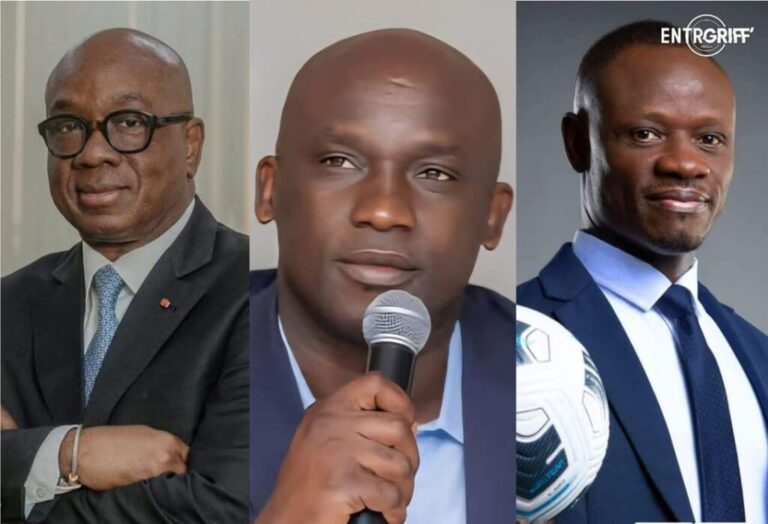
The race for the presidency of the Ivorian Football Federation (FIF) is intensifying as three heavyweight candidates have officially launched their bids for the August 2026 election.
Known as the battle for the “Glass House” in Treichville, the upcoming vote is shaping up to be one of the most competitive in the nation’s history, pitting a platform of administrative continuity against two distinct visions for radical reform.
The incumbent, Idriss Diallo, is seeking a second term following his narrow victory in the 2022 Yamoussoukro elections. Diallo is campaigning on a platform of stability and institutional growth, highlighting his record in infrastructure modernization and strengthened governance. His primary objective is to maintain the momentum of ongoing projects aimed at elevating the international profile of Ivorian football, leveraging the network and experience gained during his first tenure.
Challenging the status quo is former Ivorian international Marc Zoro, who declared his candidacy in October 2025. As the current president of the Union of Professional Footballers of Côte d’Ivoire (UFPCI), Zoro represents a growing movement for former athletes to take the helm of sports governance. Drawing inspiration from the “Renaissance” movement previously championed by Didier Drogba, Zoro’s vision centers on the professionalization of the sport, with a heavy focus on youth development and the structural modernization of local clubs.
The third confirmed contender is Souleymane Cissé, the president of Racing Club d’Abidjan (RCA), who officially entered the race on February 12, 2026. Cissé has anchored his campaign on a critique of the current domestic league, lamenting the “brain drain” of talent to neighboring countries. His strategy revolves around making national competitions more financially secure and attractive, with the goal of restoring Ivorian stadiums as centers of national pride and high-quality entertainment.
While the current field is set, the landscape remains fluid. Speculation is mounting on social media and within football circles regarding a potential bid from Malick Toé, the current vice-president of the FIF Executive Committee. Although Toé has yet to make a formal announcement, his entry would significantly alter the electoral dynamics. As Côte d’Ivoire prepares for the post-World Cup era, the choice between Diallo’s stability, Zoro’s athlete-led reform, or Cissé’s league-centric vision will define the future of the sport in the region.
AP/Sf/fss/abj/APA