



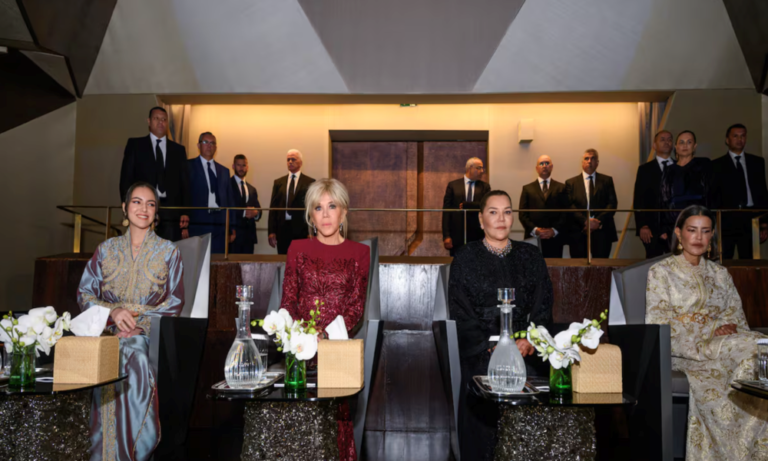
Princesses Lalla Khadija, Lalla Meryem, and Lalla Hasnaa attended the inaugural performance of the Royal Theatre of Rabat on Wednesday evening, alongside French First Lady Brigitte Macron.
Princesses Lalla Khadija, Lalla Meryem, and Lalla Hasnaa participated in the inaugural performance of the Royal Theatre of Rabat on Wednesday evening, accompanied by Brigitte Macron.
The event marks the opening of a new cultural facility presented as emblematic of the cultural policy championed by King Mohammed VI, within a context of increased support for the arts in Morocco.
Welcomed by members of the Board of Directors of the Royal Theatre of Rabat Foundation, the Princesses, joined by the wife of the French President, followed the opening protocol before taking their seats in the official box.
The ceremony is part of a broader diplomatic and cultural event, illustrating the ties between Rabat and Paris, while also highlighting the national arts scene. Following this institutional presentation, a promotional film introduced the building as “an institution symbolizing the cultural and artistic renewal of the capital,” reflecting “the cultural momentum Morocco is experiencing under the leadership of King Mohammed VI.”
The authorities emphasised its role as a tool for renewing forms of artistic expression and structuring the cultural offerings.
Located in the Bouregreg Valley, near the Hassan Tower and the Mohammed V Mausoleum, the Royal Theatre is situated along a strategic urban axis of the capital. The project is presented as an
architectural landmark aimed at positioning Rabat among major international cultural destinations and strengthening Morocco’s image as a space for cultural and civilizational dialogue.
The inaugural evening then featured a musical program centered on Moroccan artists. Pianist Marouan Benabdallah, mezzo-soprano Ahlima Mhamdi, soprano Samira Kadiri, and composer Driss El Maloumi successively performed works blending classical repertoire, opera, and Arab-Andalusian heritage, as well as contemporary compositions.
The organizers emphasized that this exclusively national artistic selection aimed to illustrate “the richness and diversity of the Moroccan music scene,” bringing together composers, soloists, and
musicians around a collective production.
The opening of the Royal Theatre thus represents a further milestone in the kingdom’s cultural
strategy, centered on creation, dissemination, and international outreach.
MK/AK/Sf/fss/as/APA