



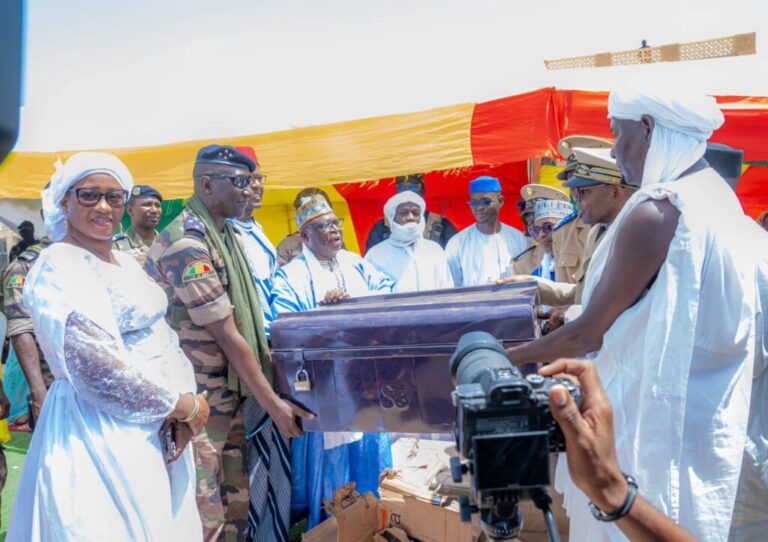
The long-awaited return of Timbuktu’s ancient manuscripts began on Tuesday with the arrival of a first batch at the Ahmed Baba Institute, following a ministerial mission marking their homecoming after more than 12 years in exile in Bamako.
A Malian army truck delivered around 5.5 tonnes of crates containing these cultural treasures to the Ahmed Baba Institute of Higher Islamic Studies and Research (IHERI-ABT). More than 27,000 documents – some dating back to the 13th century – will gradually return to the historic city after being protected in Bamako since 2012, when Islamist armed groups occupied the region.
The manuscripts, which attest to Timbuktu’s rich intellectual heritage as a former major centre of learning in fields ranging from theology and medicine to astronomy, history, and mathematics, are central to a UNESCO-backed initiative. The programme supports the rehabilitation of local libraries and provides training for the restoration and digitisation of the collections.
This milestone comes a day after a joint ministerial mission led by Minister of Reconciliation, Peace and National Cohesion Gen. Ismaël Wagué, Minister of Higher Education and Scientific Research Prof. Bouréma Kansaye, and Minister of Handicrafts, Culture, Hospitality Industry and Tourism Mamou Daffé. The visit featured an official handover ceremony and meetings with local and religious authorities.
Malian officials and local stakeholders see the restitution as both a symbol of cultural resilience and a tool for strengthening social cohesion in a region where security remains fragile. The remainder of the manuscripts is expected to follow in the coming months, reinforcing the vital link between the city’s past and its future.
ZMH/ac/sf/lb/as/APA