





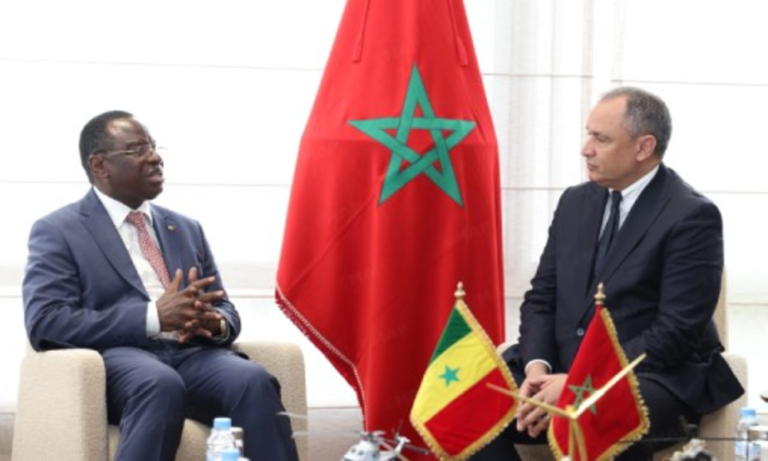
Rabat and Dakar have agreed a new framework for cooperation focused on industry, trade and capacity building, further strengthening their strategic partnership.
Ways to enhance industrial and commercial cooperation between Morocco and Senegal were at the centre of talks held on Monday in Rabat between Morocco’s Minister of Industry and Trade, Ryad Mezzour, and his Senegalese counterpart, Serigne Gueye Diop. The discussions took place on the sidelines of the 15th Morocco–Senegal Joint High Commission, according to official sources.
The talks led both sides to agree on a new roadmap aimed at structuring and deepening bilateral cooperation across several key areas. The roadmap notably covers industrial standardisation, the development and management of industrial zones, as well as the strengthening of institutional and productive capacities. The stated objective is to support the respective industrial dynamics of the two countries through a complementary, co-development approach.
Speaking to the press, Mr. Gueye Diop highlighted the deep historical ties between Senegal and Morocco. He said the exchanges focused on the main pillars of industrial cooperation at a time when Senegal is entering a new phase of development driven by the exploitation of oil and gas resources, as well as the rollout of agro-industrial zones and special economic zones. These developments, he noted, require structured support in terms of infrastructure, skills development and industrial governance.
The Senegalese minister expressed his country’s desire to draw on Morocco’s experience, particularly in industrial infrastructure, business support, industrial upgrading, training and human resource development. Agreements are planned in these areas to formalize the transfer of expertise and support the industrialization of Senegal’s productive base.
Strengthening cooperation in support of small and medium-sized enterprises was also identified as a priority. Mr. Gueye Diop recalled that SMEs account for 97 percent of Senegal’s economic fabric, underscoring the need for tailored support mechanisms. Agreements are therefore envisaged between SME support agencies in both countries, as well as between industrial upgrading institutions, to boost competitiveness and market access.
The discussions also covered fiscal policies applied to industrial zones and investments, as well as the development of bilateral trade, with particular emphasis on processed and higher value-added products. The Senegalese minister further noted his country’s interest in Morocco’s experience in the phosphate sector, announcing planned field visits, notably to OCP, to draw lessons from Morocco’s model for adding value to this resource.
Mr. Mezzour said this momentum aligns with the High Royal Guidelines, recalling King Mohammed VI’s Atlantic vision aimed at strengthening cooperation and integration among African countries. He emphasised the shared commitment of Morocco and Senegal to promoting training, skills development and industrial integration, within a South–South cooperation framework aligned with the continent’s major structural initiatives.
In this context, the 15th Joint High Commission is seen as a key lever for strengthening sectoral cooperation through structured projects, particularly in agriculture, energy, trade and the digital economy, thereby consolidating a bilateral partnership of strategic significance.
MK/ak/sf/lb/as/APA