



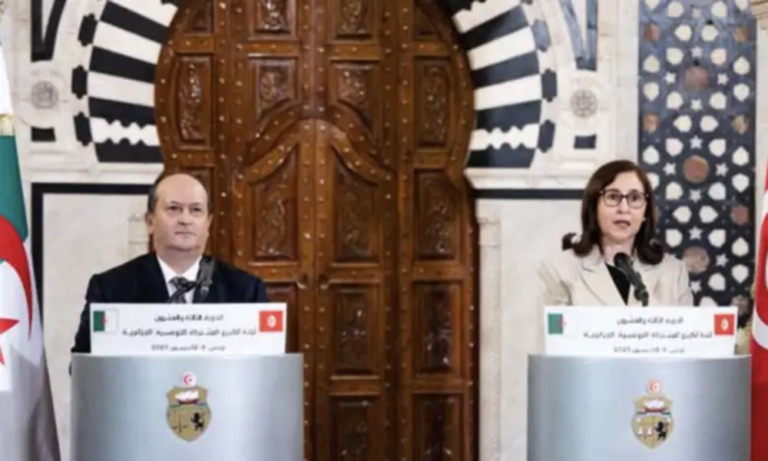
The signing of 25 agreements in Tunis marks a clear political will for closer ties between Tunisia and Algeria, but it also reveals a series of structural constraints that confine bilateral cooperation at a largely declaratory level.
Meeting on December 12, 2025, in Tunis for the 23rd session of the High Joint Commission, Tunisia and Algeria initialed 25 agreements and memoranda covering a wide range of sectors, from diplomacy and the economy to health, youth, culture, media, and energy. The meeting, co-chaired by Tunisian Prime Minister Sarra Zaafrani Zenzri and Algerian Prime Minister Sifi Ghreib, is part of a dynamic effort to strengthen relations between two neighboring countries facing converging economic and social challenges.
On the political front, this diplomatic initiative aims to demonstrate enhanced coordination in the face of a fragmented regional environment and increasing internal pressures. The agreements reached reflect a desire to strengthen institutional exchanges, particularly through partnerships between news agencies, public broadcasting media, and training organisations.
This convergence of state apparatuses, however, raises questions about the boundary between technical cooperation and political alignment, in a context where the media and institutional landscape remains tightly controlled in both countries.
On the economic front, the signed agreements cover strategic areas such as investment, transportation, fishing, health, and especially energy, a central pillar of the bilateral relationship. For Tunisia, facing persistent budgetary fragility, Algeria remains a vital partner, particularly in terms of energy supply and indirect financial support.
For Algiers, this cooperation offers leverage for regional influence and a means of consolidating its strategic reach to the east.
Nevertheless, the real impact of these agreements will depend on their concrete translation into operational projects, a recurring weakness of previous joint commissions.
Employment, training, and youth are also among the major priorities of this new roadmap. These sectors, however, concentrate the most acute social frustrations, with high unemployment, particularly among young graduates, and training systems often disconnected from the real needs
of national economies.
Without clear financing mechanisms, precise monitoring indicators, and a binding timetable, there is a high risk that these commitments will remain merely symbolic.
Beyond the diplomatic posturing, this sequence highlights an asymmetrical bilateral cooperation.
Algeria approaches these agreements from a position of relative financial strength, despite its own structural constraints, while Tunisia is primarily seeking support in a tense economic context.
The proliferation of agreements testifies to an acknowledged political alignment, but it also underscores the absence of an integrated regional economic vision capable of transcending short-term management.
MK/Sf/fss/as/APA