





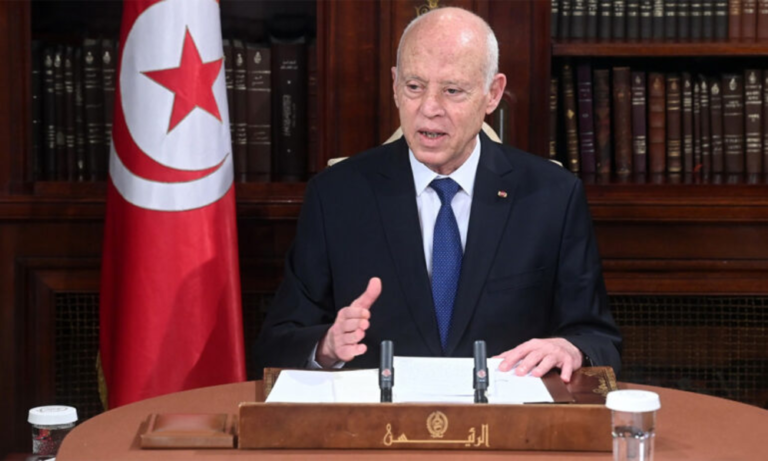
Tunisian President Kaïs Saïed has called on the national broadcaster to revise its editorial line, amid ongoing tensions with the media sector.
In a fresh public statement highlighting strained relations with state media, Saïed criticised the national television during a ceremony honouring former president Habib Bourguiba. He urged the broadcaster to “rise to the occasion of history” and “change its discourse,” without going into specifics.
Expanding on his remarks, the president also denounced what he described as “misleading propaganda,” calling on public television officials to align their content more closely with the expectations of Tunisians. He argued that “certain concepts of national television are obsolete” and no longer reflect public demand, although he did not provide concrete examples or outline specific reforms.
These statements form part of a series of recurring criticisms directed at state media by Saïed in recent months. The president has repeatedly emphasised the need for a media narrative he considers more consistent with national priorities, in a political context marked by increased centralisation of executive power.
At the same time, Tunisia’s media environment continues to raise concerns within the profession. The absence of press card issuance for 2026, combined with limited communication between authorities and journalists, has fueled uncertainty over working conditions.
Observers have also pointed to a possible resurgence of self-censorship practices in parts of the media landscape, amid what is perceived as a more sensitive operating environment for information professionals. No recent official data has been released by Tunisian authorities to document these trends.
MK/AK/Sf/lb/as/APA