



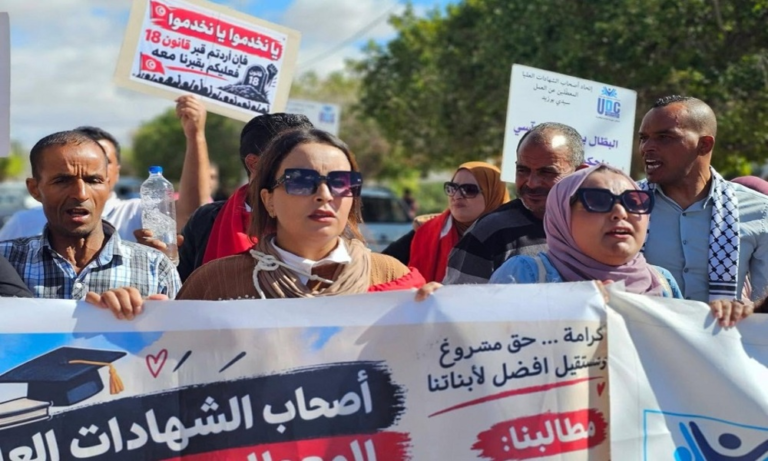
In Sidi Bouzid, unemployed university graduates demonstrated on Wednesday to demand implementation of Law 18, which provides for their recruitment into Tunisia’s public service.
They denounced the lack of funding and implementing regulations nearly 11 months after the law was passed.
The unemployed graduates gathered in Sidi Bouzid, central Tunisia to denounce the absence of budget allocations for its implementation, both in the 2026 budget and in the draft 2027 budget. The situation has fuelled frustration among young graduates facing persistent difficulties in securing employment.
The gathering took place in Mohamed Bouazizi Square, with protesters from several districts of the governorate and other parts of the country taking part. The demonstration was followed by a march to the governorate headquarters, where the protesters sought to present their demands to regional authorities.
At the heart of their protest is the gap between the law’s adoption and its translation into concrete recruitment measures.
Nearly 11 months after the law was passed, the protesters say no implementing decree has been issued, the electronic registration platform provided for under the law is still not operational, and no recruitment process has begun.
They argue that the delays are undermining the law’s intended impact and prolonging uncertainty among the graduates concerned. The lack of a clear timetable has also fuelled fears of further delays in its implementation.
Funding is one of the main sources of contention. The protesters complain that no specific budget allocation was made for implementing the law in the 2026 budget, while the draft 2027 budget also falls short of their expectations.
They are calling for the necessary funds to be allocated, implementing regulations to be issued and registration to be opened. They are also urging the ministries concerned to present a detailed plan specifying the number of potential beneficiaries and the vacant positions available within the administration.
The protesters warned that they would continue their mobilisation until their demands received a concrete response.
They called on regional authorities to forward their demands to the presidency and are seeking an official commitment setting out how and when the law will be implemented.
In Sidi Bouzid, a region associated with the outbreak of Tunisia’s 2010–2011 revolution, the protest has brought renewed attention to social expectations surrounding employment, particularly among young graduates.
MK/AK/Sf/lb/as/APA