



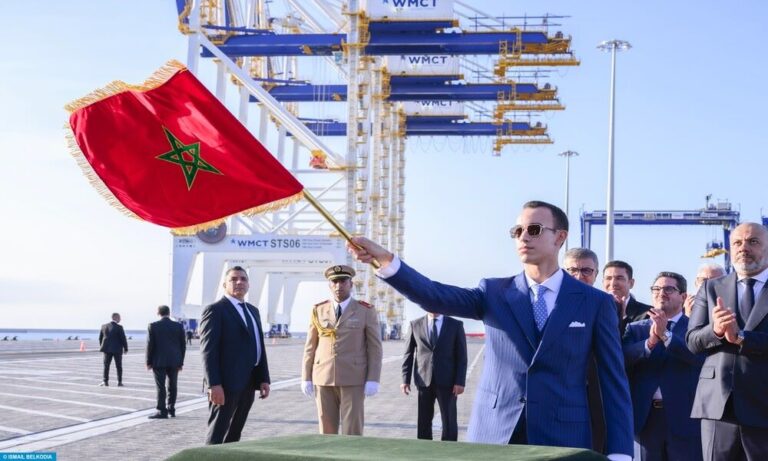
Moroccan Prince Moulay El Hassan Saturday launched operations at the first container terminal at Nador West Med on the instruction of King Mohammed VI.
The facility in the commune of Iaazzanene (Nador Province) witnessed the inaugural phase of operationalising the Nador West Med industrial-port complex.
It attracted 54 billion Moroccan dinar in public and private investment and reflects particular interest by the king to facilitate the development of major national infrastructure, which is regarded as a priority for the kingdom’s economic transformation and the emergence of new hubs of industrial, logistics, and economic growth.
It also articulates the sovereign’s readiness to provide the kingdom with a diversified, competitive, and internationally-oriented port infrastructure.
With 1,520 linear meters of quay, a draft of 18 meters, and 70 hectares of yard space, the new terminal is projected to have a capacity of 3.5 million containers by 2030.
With investments totaling approximately 5 billion dinar, the “East” terminal was conceded to a consortium comprising Marsa Maroc (Africa’s fourth-largest container terminal operator) and Terminal Investment Limited, a subsidiary of the MSC Group (the world’s leading container shipping line), which will operate and maintain the terminal for a period of 25 years.
The Nador West Med complex also includes a second container terminal, the “West” terminal, with a capacity of 1.8 million TEUs.
Conceded to a consortium comprising Marsa Maroc and CMA CGM (the world’s third-largest container shipping line), this terminal, which requires investments of approximately MAD 3 billion, features 900 linear meters of quay and 38 hectares of yard space.
It is scheduled to begin operations in April 2027, bringing the port’s total capacity to 5.3 million containers.
Nador West Med will consist of a general cargo terminal area covering 22 hectares with a capacity of 3 million tons (scheduled to begin operations in December 2028), as well as a bulk cargo terminal with a capacity of 7 million tons, scheduled for delivery in June 2027, and a roll on-roll off terminal with a capacity of 400,000 units and 380 meters of quay (delivered in September 2026).
The facility will accommodate a leading energy hub incorporating a liquefied natural gas terminal with a capacity of 5 billion m3 (360 linear meters of quay) and a hydrocarbon terminal with a capacity of 25 million tons and three 125-meter quays (scheduled to begin operations in April 2027).
The Nador West Med Industrial-Port Complex is projected to create 14,000 direct jobs and 20,000 indirect jobs in the short term, particularly for youth.
It covers an industrial and logistics hub with a land area of 700 hectares, attracting 12 billion dinar in private investment.
Infrastructure projects designed to improve access and connectivity will link this large-scale project to its surrounding area, including a 49-kilometer rail line between Selouane and Nador West Med, and a 105-kilometer highway connection from the city of Guercif. Regarded as a powerful driver of wealth creation, job creation, and opportunities, this port infrastructure is intended to foster the emergence of a new hub for industrial, logistical, and economic growth by attracting productive investments, promoting the development of new activities, and creating new sources of employment.
According to instructions from King Mohaed VI training programs will be tailored to the needs of emerging industries to promote the professional integration of young people.
Crown Prince Moulay El Hassan launched the first operation to unload a container from a commercial vessel at the “East” terminal.
The Nador West Med industrial-port complex is touted an integral part of the Royal Strategic Vision, which aims to better leverage Morocco’s comparative advantages and enable the kingdom to capture new shares of the international maritime trade market between the Mediterranean basin, Europe, the Middle East, and Asia.
Nador West Med is seen as consolidating the momentum initiated by Tanger Med, as part of a strategy of complementarity aimed at equipping the kingdom with a diversified, competitive, and internationally-oriented port infrastructure.
This ambition is also unfolding along the Atlantic coast through the Dakhla Atlantique project, set to bolster Morocco’s foothold in Africa and offer the countries of the Sahel privileged access to international markets.
While at the Nador West Med Industrial-Port Complex, Crown Prince Moulay El Hassan reviewed a detachment of the Royal Guard that performed the honours, before being greeted by the Minister of Economy, Finance, and Public Performance, the Minister of Infrastructure, Water, and Forests, and the Minister of Industry, Trade, Investment, and Economic Inclusion.
WN/as/APA