



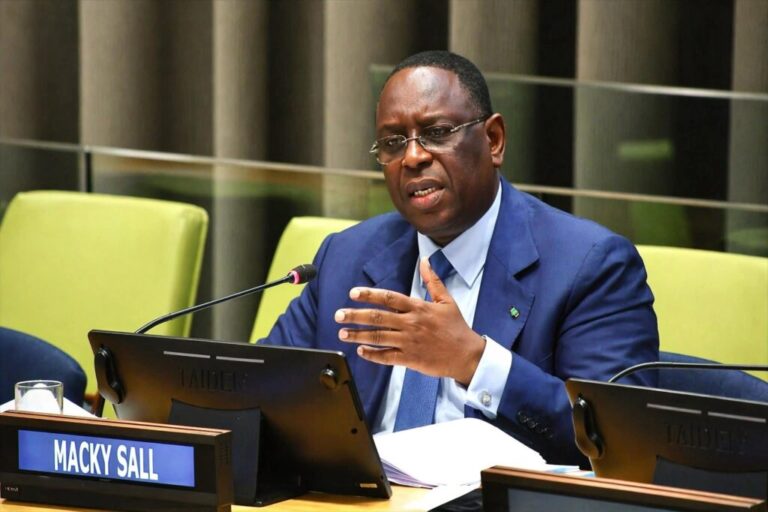
Former Senegalese president Macky Sall Tusday laid out a comprehensive vision for a reform-embracing United Nations, built on trust, efficiency, crisis prevention and renewed multilateralism.
During his hearing before the United Nations General Assembly, Sall said these should be in response to the world’s systemic challenges.
The trained geological engineer was heard on Wednesday by the UN General Assembly as part of the process to select the next Secretary-General, presenting a broad platform focused on reforming multilateralism, addressing contemporary crises and transforming the institution internally.
Addressing the President of the General Assembly, representatives of member states, international organisations and civil society, the candidate began by acknowledging his competitors before outlining the core of his project: to make the Secretary-General a “bridge-builder” capable of restoring trust in an organisation weakened by international divisions.
In a candid assessment, he described a world facing “systemic” rather than cyclical challenges: intensifying geopolitical rivalries, a proliferation of armed conflicts, heightened vulnerability to climate change, growing economic and social fragilities, and migration pressures.
These crises are compounded by rapid technological transformation, particularly artificial intelligence, which he said presents both risks and opportunities if properly governed.
Against this backdrop, he reaffirmed the indispensable role of multilateralism in achieving the UN’s core objectives: maintaining international peace and security, protecting human rights, promoting development, and strengthening cooperation among nations.
Highlighting nearly four decades of experience in public service — spanning roles as a civil servant, mayor, minister, prime minister, president of the National Assembly and head of state — Macky Sall underscored his deep understanding of state mechanisms and international dynamics. He pointed to his engagement in high-level dialogue, particularly with African leaders and within forums such as the G7 and G20, as well as his ability to drive reforms and arbitrate priorities in complex environments.
On the operational front, he identified restoring trust among member states and within global public opinion as a key priority. He pledged to act as an impartial Secretary-General, attentive to all parties, and committed to more proactive preventive diplomacy based on early warning, mediation and strengthened cooperation between the UN and regional organisations. He also called for a thorough review of the effectiveness of peacekeeping operations.
The candidate reaffirmed his commitment to the centrality of human rights, emphasising their universal and indivisible nature across civil, political, economic, social and cultural dimensions. He stressed the need to ensure their protection in line with the rule of law and the demands of justice.
On development, he highlighted the urgency of accelerating implementation of the 2030 Agenda, with four years remaining before its final assessment, while also preparing the post-2030 framework. He drew attention to the rising debt burden in many developing countries, persistent inequalities — particularly affecting youth and women — and the limitations of traditional public financing.
To address these challenges, Macky Sall proposed a renewed approach to development financing, placing greater emphasis on partnerships, private investment and trade, supported by improved access to credit. He also pointed to the potential role of the Financing for Development Forum as a lever for economic transformation and job creation, arguing that such dynamics would also help tackle the root causes of irregular migration.
Institutionally, he advocated for in-depth UN reform based on three pillars: “rationalise, simplify, optimise.” He stressed the need for better coordination among agencies, funds and programs to avoid duplication and enhance the effectiveness of field operations, while ensuring transparent and rigorous resource management.
He also expressed support for a consensual reform of the Security Council aimed at strengthening its legitimacy, authority and effectiveness, in line with ongoing discussions among member states.
In a final appeal, Macky Sall said the world stands “at a crossroads” between fragmentation and unity, warning that the UN’s credibility will depend on its ability to deliver concrete, coherent and equitable results. He urged member states to make “bold” choices to enable the organisation to “do more with less” and fully harness its potential.
“Now is the time to act,” he concluded, calling for collective mobilisation to restore the UN’s relevance and its capacity to embody a shared future based on cooperation and international solidarity.
AC/Sf/lb/as/APA