






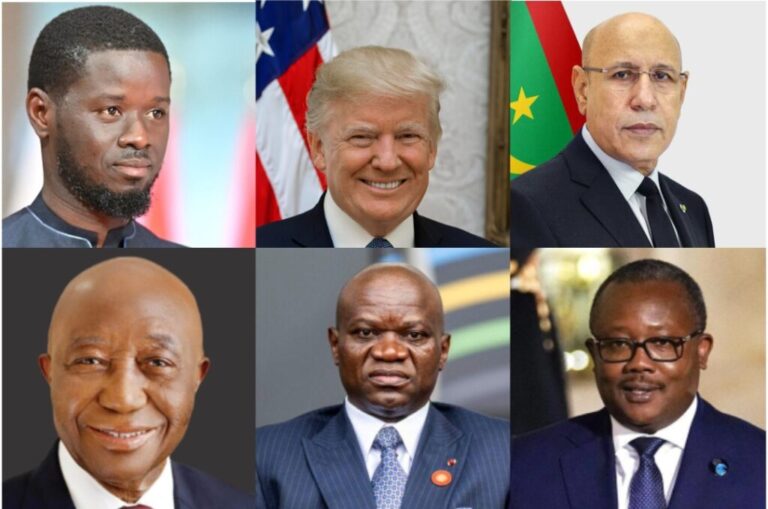
Five African heads of state, including Senegal’s Bassirou Diomaye Faye, commenced a three-day visit to Washington today at the invitation of U.S. President Donald Trump.
This mini-summit signals the United States’ intensified efforts to bolster economic and security partnerships with Africa, even as it navigates complex issues related to its migration policies and growing geopolitical competition with China and Russia.
President Trump is hosting his counterparts from Senegal (Bassirou Diomaye Faye), Mauritania (Mohamed Ould Cheikh El Ghazouani), Liberia (Joseph Nyumah Boakai), Gabon (Brice Clotaire Oligui Nguema), and Guinea-Bissau (Umaro Sissoco Embaló) at the White House. This gathering, described by the State Department as a “targeted” follow-up to the 17th US-Africa Business Summit held last week in Luanda—which saw over $2.5 billion in agreements signed—marks President Trump’s first multilateral meeting of this kind since his return to the White House. The discussions are primarily focused on strategic investments, maritime security in the Gulf of Guinea, access to critical minerals, and combating organized crime. The agenda includes both bilateral meetings and a plenary session with the five leaders, all representing coastal nations deemed strategically vital to U.S. interests in the Atlantic.
A dialogue under constraint: Migration and geopolitical tensions
This push for deeper economic cooperation unfolds paradoxically against a backdrop of Washington simultaneously considering imposing migration restrictions on 25 African countries, including four of the nations participating in this mini-summit. According to documents cited by Reuters and The Washington Post, Senegal, Mauritania, Gabon, and Liberia—whose leaders are currently in Washington—appeared on a list sent to African foreign ministries in mid-June. The justification for these potential restrictions cites “problems with the reliability” of identity documents and “administrative fraud,” a rationale that critics argue undermines the American narrative of a “win-win” partnership.
Dr. Alioune Aboutalib Lo, a researcher at the AKEM Center in Istanbul, observes, “The presence of these five Atlantic-bound states reflects the importance the United States places on controlling coasts vital to maritime trade, rich in resources in a region marked by Russo-Chinese competition.” He suggests that the establishment of Russian military bases, arms deliveries via Conakry, and military agreements with Togo and Sao Tome and Principe are causing significant concern in Washington and among its NATO allies.
Senegal’s assertive diplomacy and economic resilience
In this intricate geopolitical environment, Senegal distinguishes itself through a more assertive diplomatic stance. Recent actions, such as Prime Minister Ousmane Sonko’s cancellation of a sports training program in the United States following a visa refusal, and the priority given to a visit to Beijing, exemplify a posture of sovereignty that, according to Dr. Lo, “cannot leave Washington indifferent.” While the United States may leverage economic tools—such as the potential suspension of USAID funding, aid reform, and the uncertain renewal of AGOA—to secure concessions, President Bassirou Diomaye Faye’s Senegal demonstrates a clear commitment to “transparent governance and balanced partnerships,” which could complicate American expectations.
Despite these underlying tensions, economic relations between Dakar and Washington remain robust. A bilateral investment treaty in place since 1983 has attracted American capital into energy infrastructure, and bilateral trade reached $586 million by 2024, with Senegalese imports experiencing a 48 percent increase. The “New Technology Deal” announced by President Faye during a recent tour of Silicon Valley and ongoing investment projects in Angola further illustrate this dynamic. More broadly, US-Africa trade is projected to reach nearly $72 billion in 2024, with investment commitments totaling $2.5 billion announced at the June summit. This Washington mini-summit also serves as a preparatory meeting for a larger gathering scheduled for September, on the sidelines of the United Nations General Assembly.
Call for enhanced African coordination
Facing what he describes as Trump’s unpredictability and persistent asymmetry in relations, Dr. Lo recommends “better African coordination to gain more leverage in the negotiations.” For leaders like Bassirou Diomaye Faye, Mohamed Ould Cheikh El Ghazouani, Joseph Nyumah Boakai, Brice Clotaire Oligui Nguema, and Umaro Sissoco Embaló, this meeting represents a critical opportunity to advance their respective economic priorities while steadfastly preserving their diplomatic autonomy.
MB/ac/fss/abj/APA