





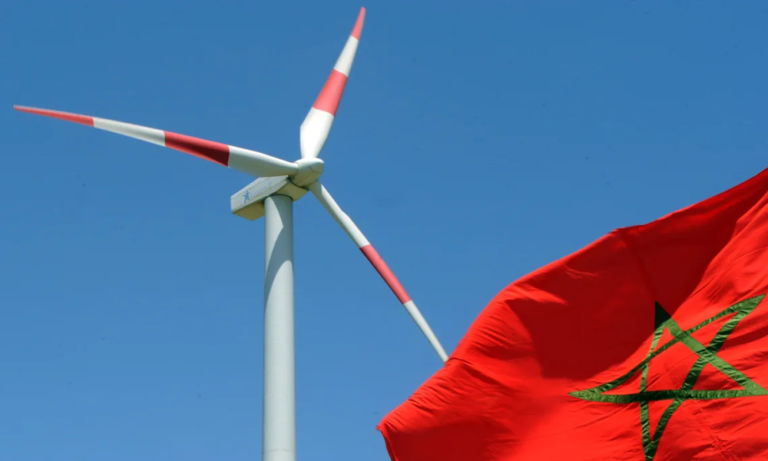
Driven by an unprecedented surge in capacity, wind energy is establishing itself as the central pillar of Morocco’s energy transition, contributing to record renewable production and a gradual decline in fossil fuels.
In 2024, wind energy established itself as the main component of Morocco’s national electricity mix, according to the latest annual report from the National Electricity Regulatory Authority (ANRE).
By the end of December, installed wind capacity reached 2,390 MW, an 18.5% increase year-on-year, now representing nearly 20% of the kingdom’s total electricity capacity. This progress is part of a context of sustained demand and a structural rebalancing of the Moroccan energy system in favour of renewable sources.
This dynamic is primarily driven by the commissioning of two structuring projects. The Jbel Lahdid wind farm, with a capacity of 270 MW near Essaouira, was developed under an Independent Power Producer (IPP) contract with the National Office for Electricity and Drinking Water (ONEE). Added to this is the modernisation project of the historic Koudia Al Baida site in Tétouan, which injected an additional 100 MW into the grid in partnership with the Moroccan Agency for Sustainable Energy (MASEN).
In terms of production, wind power crossed a record threshold. In 2024, it generated 9,363 GWh, marking a 43% increase compared to 2023. This output alone accounted for 21% of national electricity and nearly 80% of all renewable production. Independent Power Producers (IPPs) supplied 47% of this, while private operators in the liberalized market provided 43%, with ONEE, MASEN, and self-producers sharing the remaining volumes.
In total, installed renewable energy capacity reached 5,439 MW, now covering 45% of the national electricity mix. Wind power leads with 44%, ahead of hydroelectricity (24%), solar (17%), and pumped-storage power stations (15%). Overall renewable electricity production stood at 11,666 GWh, an annual increase of 27%.
This rise in capacity has been accompanied by contrasting developments in other sectors. Solar capacity reached 928 MW, but production fell by 25% to 1,617 GWh due to the temporary unavailability of the Noor III power plant in Ouarzazate, with MASEN concentrating 86% of this production.
Simultaneously, the Abdelmoumen pumped-storage power station, commissioned in October 2024, added 350 MW of flexibility to the system, with an initial output of 135 GWh.
MK/sf/lb/as/APA