



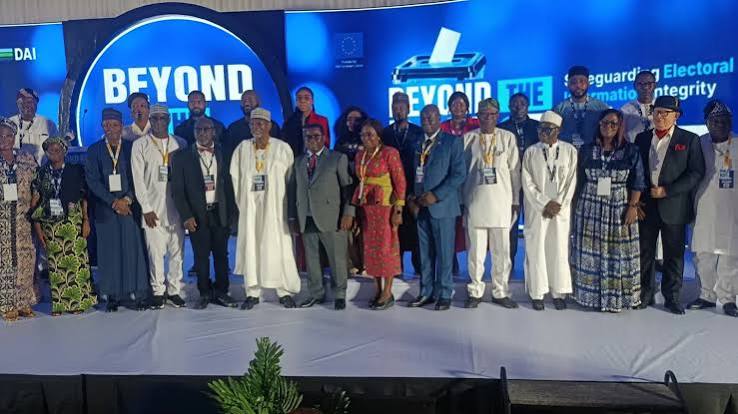
The European Union (EU) and the International Press Centre (IPC) have warned against the growing threat of information manipulation, deepfakes, and Artificial Intelligence (AI) and generated political disinformation ahead of Nigeria’s 2027 general elections.
Speaking at the opening of a two-day Summit on Electoral Information Integrity in Abuja on Monday, with the theme “Beyond the Ballot: Safeguarding Electoral Information Integrity in the Age of AI”, the EU Ambassador to Nigeria and ECOWAS, Gautier Mignot emphasised the need for protecting the integrity of electoral information so that citizens could freely make their choices.
He urged stakeholders to build an electoral and information environment in which reliable information is available, institutions communicate credibly, independent journalism could flourish, and manipulation meets a prepared response.
“An election can be undermined without a single ballot being altered. A fabricated announcement can send voters to the wrong location.
“A false claim about results can deepen suspicion before verified information reaches the public. The immediate target is information; the deeper target is trust,” Mignot said.
The EU envoy noted that information manipulation during election periods is a global phenomenon affecting both Europe and Africa.
He cautioned that while artificial intelligence supported accessibility and translation, it also made deception easier to produce and harder to spot.
“Yet, we should not make technology the whole story.
“A misleading message does not need sophisticated AI to cause harm, nor should uncertainty about whether a recording is AI-generated prevent us from checking whether the instruction it contains is genuine.
“The task is, therefore, broader than detecting deepfakes.
“It is to build an electoral and information environment in which reliable information is available, institutions communicate credibly, independent journalism can flourish, and manipulation meets a prepared response,” he said.
The ambassador highlighted the importance of timely public information, independent fact-checking, and stronger capacity to address harmful content in local languages.
Mignot also outlined three key priorities for Nigeria as it prepared for the 2027 polls.
These, according to him, include early preparedness before pressure mounts, operationalising local and international partnerships, and protecting fundamental democratic rights while safeguarding the information space.
“Election day is too late to establish verification contacts, clarify responsibilities, or agree on who can authorise a public correction. Those arrangements should be developed and tested now,” he said.
He emphasised the need for journalists to retain editorial independence, fact-checkers to remain free to reach their own conclusions.
“INEC must communicate within its authority. Platforms must explain their decisions and provide appropriate routes for review,” he said.
Mignot added that efforts to counter misinformation must never be used to suppress political criticism, silence journalists, or violate citizen rights.
“It is important to protect democratic rights while protecting electoral information.
“Countering manipulation must never become a justification for silencing criticism, suppressing inconvenient reporting, or treating political disagreement as a threat.
“A citizen questioning an institution is not necessarily spreading misinformation. A journalist reporting a failure is performing a democratic function,” he said.
He clarified that the EU remained committed to supporting Nigerian-led solutions without dictating political outcomes.
In his remarks, the Executive Director of the International Press Centre (IPC), Lanre Arogundade, warned that the terrain of electoral information had shifted significantly since the 2023 elections.
Citing data from the Nigeria Fact-Checkers Coalition, Arogundade recalled that 63 per cent of presidential and national assembly claims reviewed in 2023 were entirely false, while false claims reached secondary social media platforms in an average of 11 minutes.
“Turnout in that election fell to 26.7 per cent, the lowest since 1999,” Arogundade noted.
He also disclosed that out of Nigeria’s 148 million internet users, a recent survey revealed that 52 per cent get political news primarily from social media, with figures reaching over 82 per cent in the South-East, where more than four in 10 voters did not verify what they received.
He noted that voice cloning, forged result sheets, and the dismissal of authentic evidence as “AI-generated” posed dangerous challenges to public accountability.
Arogundade called on the participants of the summit drawn from INEC, security agencies, political parties, media organisations, tech platforms, telecommunications operators, fact-checkers, and civil society, to move beyond declarations.
He urged stakeholders to establish an Electoral Information Integrity Response Protocol and adopt the “Abuja Commitment” to establish an operational framework ahead of the 2027 elections.
“Awareness alone is insufficient. Nigeria needs a trusted, coordinated, rights-respecting system enabling institutions to anticipate threats, verify evidence, escalate incidents, and communicate authoritatively,” Arogundade said.
He added that while the Independent National Electoral Commission (INEC) recently announced steps, including its new AI unit, and assurance that algorithms would not decide the 2027 vote, stakeholders must put necessary measures in place.
“We must ensure that all institutions, and systems, and the people are ready, and safeguards in place before voting begins in 2027,” he said.
The Summit, organised by the IPC, IDA and others, was supported by the European Union Support to Democratic Governance in Nigeria (EU-SDGN).
GIK/APA