





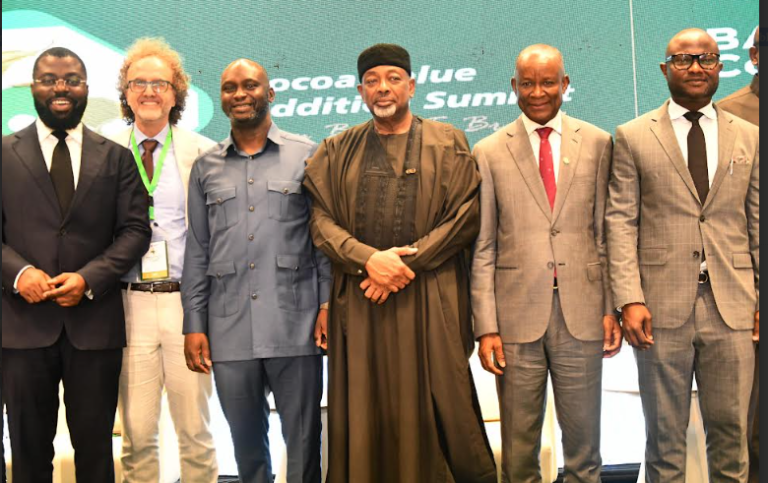
The Managing Director/CEO of Bank of Industry (BOI), Olasupo Olusi, says that the bank disbursed over ₦164 billion in 2025 to more than 3,500 agro and food-processing businesses.
Olusi told the Africa Cocoa Summit convened in Abuja by the Federal Ministry of Industry, Trade and Investment with the aim of transitioning Africa from exporting raw beans to local processing and branding, that the support financed factories, mills, pack houses, and cold chains, and linked nearly 48,000 smallholder farmers into industrial value chains.
He announced that the BOI has secured 60m euros to fund Nigeria’s cocoa, dairy value addition and that the new financing would target the entire ecosystem, from nurseries and farmer cooperatives to grinding plants, ingredient factories, packaging lines, and chocolate manufacturers.
According to him, the €60 million forms part of the €85 million EIB–BOI facility, backed by the European Union under the Global Gateway initiative, and designed specifically to strengthen these critical sectors in Nigeria.
“This agreement reinforces the Bank of Industry’s commitment to unlocking long-term, affordable finance for priority sectors that drive inclusive growth. Approximately 70% of the €85 million financing facility will be channeled to Nigeria’s cocoa and dairy sectors, which BOI considers among the industries with the greatest potential to create jobs and retain foreign exchange earnings,” Olusi said.
“We are particularly focused on cocoa value chains, which provide livelihoods for thousands of Nigerians. Through this initiative, we aim to enhance productivity, value addition, and market linkages that will directly improve the incomes of farmers and processors,” he stated.
He explained that the bank would prioritise lending to processors, cooperatives, and MSMEs that add value locally, rather than only to traders exporting raw beans, adding that the era of celebrating volume of raw exports must end, as Nigeria loses billions by shipping beans and importing finished chocolate.
According to him, the goal is to create factories around cocoa communities so that value, jobs, and taxes remain in Nigeria.
However, Olusi noted that financing alone is not enough, and as such, BOI will complement the loans with technical assistance on compliance, climate standards, and access to the EU market.
BOI, he said, would also support farmers and processors to meet the EU Deforestation Regulation and other international environmental and social standards.
The Cocoa Value Addition Summit with the theme: ‘From Bean to Brand,’ was attended by leaders and stakeholders from Nigeria, Ghana, Côte d’Ivoire, and Cameroon who signed the Abuja Declaration to establish the Cocoa Value Addition Alliance (CVAA).
GIK/APA