





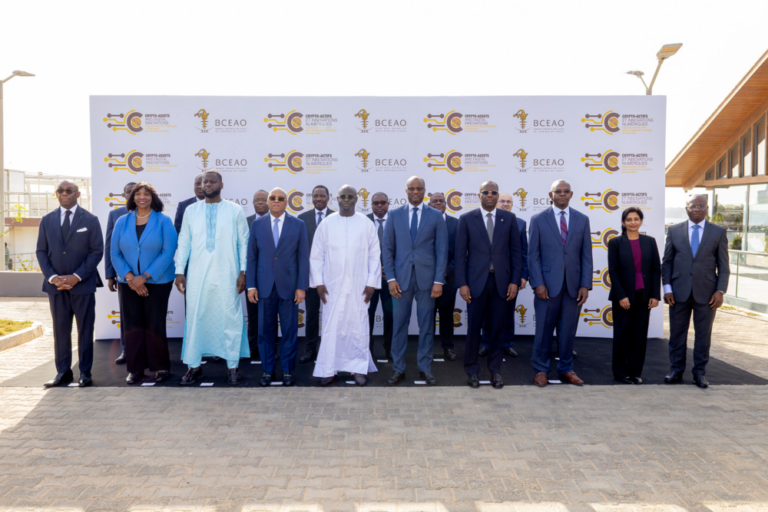
African political and monetary leaders say they are determined not to be left behind by the global financial transformation, while also raising concerns about the risks these new instruments pose to monetary stability, financial regulation, and the economic sovereignty of states.
They had gathered at an international conference in Dakar, Senegal dedicated to crypto-assets and digital innovations.
As crypto-assets disrupt traditional financial systems worldwide, the authorities of the West African Economic and Monetary Union (UEMOA) intend to define their own approach to this technological shift, balancing openness to innovation with the management of emerging vulnerabilities.
Crypto-assets, digital platforms, and the digitalisation of financial services are “fundamentally redefining the methods of financial intermediation, while challenging traditional regulatory and supervisory frameworks,” emphasised the Governor of the Central Bank of West African States (BCEAO), Jean-Claude Kassi Brou.
According to him, these transformations constitute “powerful levers for modernisation,” capable of improving payment efficiency, stimulating innovation, and strengthening financial inclusion within
the West African community.
However, he called for increased vigilance regarding the risks associated with these technologies, citing the volatility of crypto-assets, cybersecurity threats, the risks of money laundering and terrorist financing, as well as their potential repercussions on “the conduct of monetary policy and financial stability.”
A similarly cautious tone was adopted by the Senegalese authorities. Representing the host country’s government, the Minister of Finance and Budget, Cheikh Diba, described crypto-assets as “a crucial issue of modern times that is challenging our borders,” with direct implications for
“the stability of our financial systems and the future of our economies.”
He commended the BCEAO’s initiative in bringing together public decision-makers, monetary authorities, experts, and academics in Dakar to “collectively reflect on the ongoing transformations in global finance.”
This conference comes as several African central banks accelerate their deliberations on digital currencies and regulatory frameworks adapted to digital assets.
According to Jean-Claude Kassi Brou, some institutions on the continent have already adopted specific regulatory mechanisms, while others are exploring the development of central bank digital
currencies (CBDCs), intended to offer regulated alternatives to private crypto-assets.
For African monetary authorities, the issue goes beyond mere technological innovation. It also involves preserving the financial sovereignty of states in a digital environment dominated by global
players and cross-border flows that are difficult to control.
In this context, Cheikh Diba indicated that “Senegal actively supports the BCEAO (Central Bank of West African States) in initiating discussions on the development of a regional regulatory framework for crypto-assets,” aimed at harmonising practices, strengthening cross-border supervision, and protecting consumers, while preserving “the necessary space for the emergence of innovative players in African finance.” “The monetary authorities of developing countries, particularly those on the African continent, want to fully participate in international dynamics of financial innovation, while preserving the imperatives of financial stability, security, and sovereignty,” concluded the Governor of the BCEAO.
This meeting in Dakar is the third international conference organised by the BCEAO on major global transformations, following those dedicated to climate change in 2024 and artificial intelligence in
2025.
It brings together governors and deputy governors of African central banks, as well as representatives from the International Monetary Fund, the World Bank, the Bank for International Settlements, and the Federal Reserve of the United States.
ARD/te/Sf/fss/as/APA