





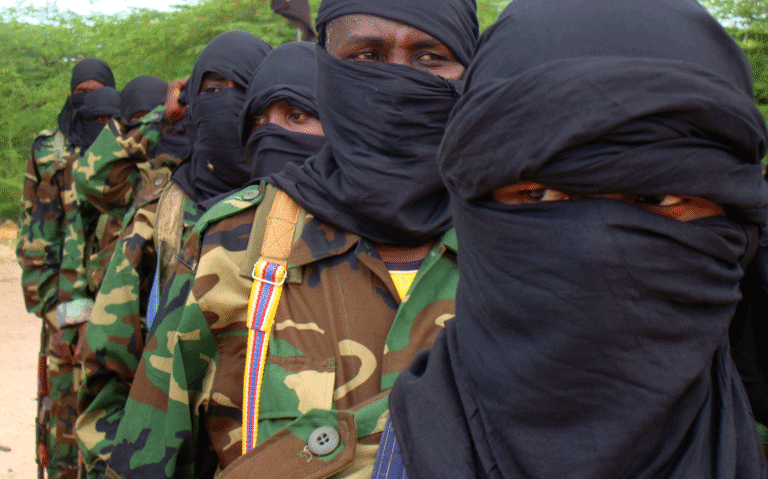
al-Shabaab suffered seven fatalities as its militants attacked the main prison in Mogadishu on Saturday in a daring raid which all but suggest that the militant group is far from being routed by a coalition of the country’s military and an African Union force.
Observers say this raid proves beyond doubt that despite suffering spectaclar losses in its insurgency against the governent backed by the African Union in recent years, the militants are adept at adapting to their new reduced circumstances with their lethal efficiency intact.
The attack was meant to free some of their convicted fighters serving time in the Godka Jilicow detention facility located at the heart of the Somali capital where security is always tight.
However, despite several security layers being kept in the area, Shabaab fighters still managed to breach them using deception as a weapon and later applying explosives and rifles to engage security forces before being shot dead.
They used disguises including posing as uniformed government soldiers on amoured vehicles to gain access to the heavly-fortified facility, confronted guards before allegedly freeing their fellow militants, according to a statement linked to the group. They also claimed the attack took a heavy toll on the security forces defending the prison facility.
The government has not commented on al-Shabaab claims, but the attack raises serious questions about the level of security in and around key installations in Mogadishu and al-Shabaab’s seeminglly undiminished capability to strike at the heart of the capital especially in an area very close to the seat of power, the presidential palace.
Godka Jilicow is known for holding high profile political prisoners including captured Somalis convicted of fighting for al-Shabaab. It is under constant watch by the National Intelligence and Security Agency (Nisa).
Already the Nisa and its reputation is coming under scrutiny since the attack in an area of the capital which is the most heavily guarded areas in the city.
al-Shabab which is sworn to overthrowing the Western-backed government in Somalia and introducing a theocratic Islamic state has been waging an insurgency since 2006.
With some sweeping security operations carried out by the African Union Support and Stabilization Mission in Support (AUSSOM) and the National Security Forces (NSS) in recent years, al-Shabaab’s presence in some parts of the country including the capital has thinned. However pockets of militants remain in outlying areas from where they can still launch raids targeting the city and its environs.
The al-Qaeda affiliated group still retains a capacity to strike targets as several attacks earlier this year have shown.
AUSSOM while condemning the latest attack resolved to work with the national security agencies in Somalia to eliminate the threat pose by al-Shabaab and other armed groups active in the country.
A day after militants raided the Mogadishu prison, AUSSOM issued a statement on Sunday claiming spectacular success against the mlitants in the town of Awdheegle in the Lower Shabelle region. It said the militants have been routed and the town recaptured.
”The successes achieved in the joint military operations are proof that Somalia is on the verge of achieving peace and stability its citizens have been yearnin for” the statement said.
Allthough success against the militants on the ground are well documented, Somalis especially those living in Mogadishu have been wary of al-Shabaab as an enduring group which has been driven from much of their strongholds elsewhere in the country.
Security analysts say the operations of the past ten years have seen al-Shabaab going on the retreat but attacks like the one on Godka Jilicow prove just how far the group is from being a force defeated for good.
”They have adapted to setbacks on the battlefield for years and their capability for sporadic attacks remains unaffected” said one on condition of anonymity.
Even territorial successes against the militants have been far from conclusive in some areas. In May, it was noticed with some alarm that al-Shabaab has been winning back territories previously recaptured by Ugandan troops under AUSSOM especially in Hiraan region, in central Somalia.
In recent months al-Shabaab have been taking back some of the territories which were wrested from its control by an allied of tribal militias backed by US and Turkish air strikes two years ago.
There were reports of Mogadishu within range of the militant mortars last July during fighting with AUSSOM and Somali troops. Although normalcy has largely returned to some areas, fears of the militants’ advance on the capital had barly subsided when the latest attack happened.
According to the Council on Foreign Relations’ Global Conflict Tracker last month, ”in 2022, there was a 41 percent increase in al-Shabaab violence targeting civilians. Fleeing from government forces, some al-Shabaab fighters have reportedly started to move northward, where political instability in Puntland and Somaliland could provide an opportunity for al-Shabaab to expand its presence”.
It said the militants inflicted a heavy toll on AU forces through ambushes such as the one which took place on June 6, 2023 that killed fifty-four Ugandan peacekeepers at a peacekeeping base.
al-Shabaab has ot spared neighbouring Kenya and Ethiopia where its militants launched sporadic incursions along their shared borders, prompting planned retaliatory raids by the security forces of those countries.
al-Shabaab’s recent resurgence is thanks in no small part to an alliance with Houthi rebels across the Red Sea in strife-torn Yemen.
This deal has allowed al-Shabaab logistical support from the Yemeni rebels including arms and other gadgets of operation exchange for intelligence and access to territories under the control of the militants inside Somalia which would service as a launchpad for its own operations against international shipping and piracy.
Egypt recently sent a large contingent of troop to help secure the Somali government and its installations as Turkey and the United Arab Emirates intensify their involvement with military training and air support.
There is also the threat of the Trump White House pulling out of the fight against al-Shabaab altogether. There are reports suggesting that President Trump is now more in favour of shifting American attention from counterterrorism campaign in East Africa to tackling domestic security challenges. This is leaving wide open the chance of slackening or even abandoning the crusade against the Somali militants three years after President Sheikh Hassan Mohamud declared war on the group.
WN/as/APA