



Billed by authorities as one of the world’s richest zinc deposits, the Amizour mining project has reignited the debate over natural resource management in Algeria — caught between ambitions of economic diversification and the structural limits of the country’s economic model.
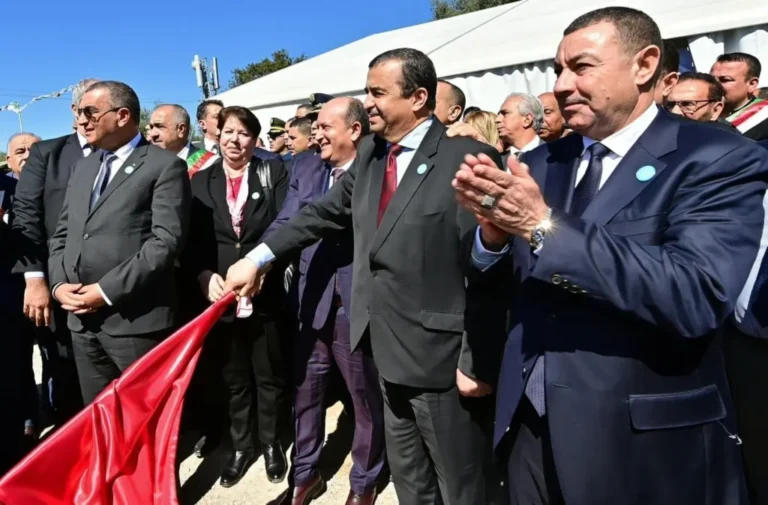
The Algerian government officially launched on Tuesday, the development works related to the exploitation of the zinc and lead deposit located between Amizour and Tala Hamza, in the wilaya of Béjaïa. The ceremony was presided over by Prime Minister Sifi Ghrieb, acting on instructions from President Abdelmadjid Tebboune.
Authorities are presenting the project as one of the most significant in the national mining sector, carried by the joint venture Bejaia Zinc and Lead in partnership with the state-owned group Sonarem.
According to official data, the mine is expected to produce approximately 170,000 tonnes of zinc and 30,000 tonnes of lead per year, with the aim of meeting the needs of domestic industry while generating a surplus for export. For the government, the project forms part of its stated economic diversification strategy, in a country whose economy remains heavily dependent on hydrocarbons.
To support the site’s operations, several infrastructure projects are planned. Authorities announced the construction of a connecting road linking the mine to the main highway, as well as connections to the electricity and gas networks, including a 60 kV power line. The port of Béjaïa is also expected to play a central role in the logistics chain, particularly for the export of processed metals.
Authorities also maintain that the project meets strict environmental standards. According to figures presented at the ceremony, the area under exploitation would represent less than 2% of the region’s water basin. Industrial water management systems and heavy metal treatment facilities have been announced, alongside techniques for reinjecting mining waste into underground cavities to limit environmental impact.
Behind the announcements, however, several observers point to the structural contradictions of Algeria’s economic model. Despite its considerable natural resources — hydrocarbons, minerals and rare earths — the country has struggled for decades to translate these riches into genuine economic diversification. Repeated attempts to revive the mining sector have run into persistent obstacles: heavy bureaucracy, an uncertain investment climate, a lack of technology and weak appeal for foreign capital.
The Amizour project thus illustrates a recurring paradox in the Algerian economy: an abundance of natural resources has yet to give rise to a truly competitive industrial ecosystem. While the exploitation of this deposit could generate foreign currency earnings and create local jobs, its macroeconomic impact will remain limited as long as Algeria fails to push through deeper structural reforms aimed at improving economic governance, attracting investment and developing a higher-value-added processing industry.
In this context, the launch of the mining project looks as much like a political symbol of diversification as it does a test of the Algerian economy’s real capacity to break free from its chronic dependence on energy revenues.
MK/AK/lb/as/APA