



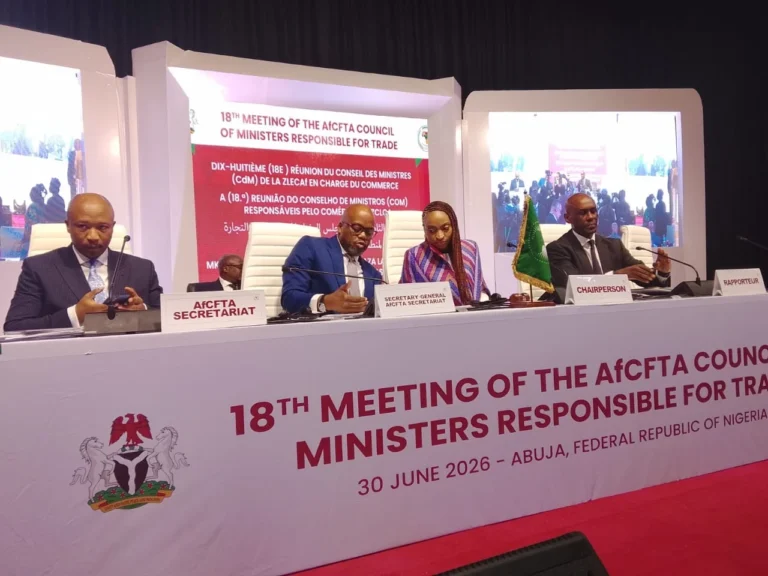
The Nigerian Government has urged African countries to accelerate the implementation of the African Continental Free Trade Area (AfCFTA) in order to drive industrialisation, digital trade and shared prosperity.
Nigeria’s Minister of Industry, Trade and Investment, Dr Jumoke Oduwole, told the 18th Meeting of the AfCFTA Council of Ministers Responsible for Trade, on Tuesday in Abuja that Nigeria would prioritise faster implementation by ensuring that member states move from commitments to concrete actions under the agreement.
According to her, African countries should move from AfCFTA commitments to concrete actions that deliver jobs, trade and economic growth.
“Africa must shift from negotiating agreements to ensuring AfCFTA delivers tangible benefits for businesses, producers, women, youths and more than 1.4 billion Africans.
“African countries should also strengthen regional value chains to increase trade in goods produced across the continent,” she said.
The Nigerian minister also called for investment in digital public infrastructure, interoperable payment systems and trusted cross-border data flows to support digital commerce.
She advocated expanded access to finance through the AfCFTA Adjustment Fund and other mechanisms, especially for women-led businesses, youths and MSMEs.
The minister also urged member states to embrace emerging legal instruments, including electronic cargo documentation, to modernise trade, reduce costs and improve customs efficiency.
Oduwole pledged that Nigeria would work with all member states to ensure AfCFTA becomes Africa’s engine of growth, industrialisation and shared prosperity.
She disclosed that Nigeria had implemented major reforms since ratifying the agreement to maximise opportunities under the continental free trade arrangement.
According to her, Nigeria operationalised the AfCFTA coordination office and developed a national implementation strategy to drive whole-of-government execution.
“Nigeria also submitted its schedule of tariff concessions and specific commitments under the Protocol on Trade in Services.
“The country has as well advancing digital trade as Co-Champion of the AfCFTA Digital Trade Protocol through regulatory collaboration across African countries,” she said.
In his speech, the Secretary-General of AfCFTA, Dr Wamkele Mene, said that negotiations on the agreement’s legal instruments had been concluded, shifting attention from legal frameworks to accelerated implementation across member states.
Mene said that the implementation was gaining momentum, with over 10,000 certificates of origin issued under the agreement by the end of March 2026.
“Africa’s total trade is projected to grow by about 10 per cent in 2026, with intra-African trade expected to reach about 230 billion dollars.”
The secretary-general urged member states to ratify outstanding protocols, establish national implementation committees and integrate AfCFTA into development plans and budgets.
He also called for sustainable financing of the AfCFTA secretariat, adding that predictable funding was essential to support implementation, industrialisation and Africa’s long-term economic transformation.
GIK/APA