





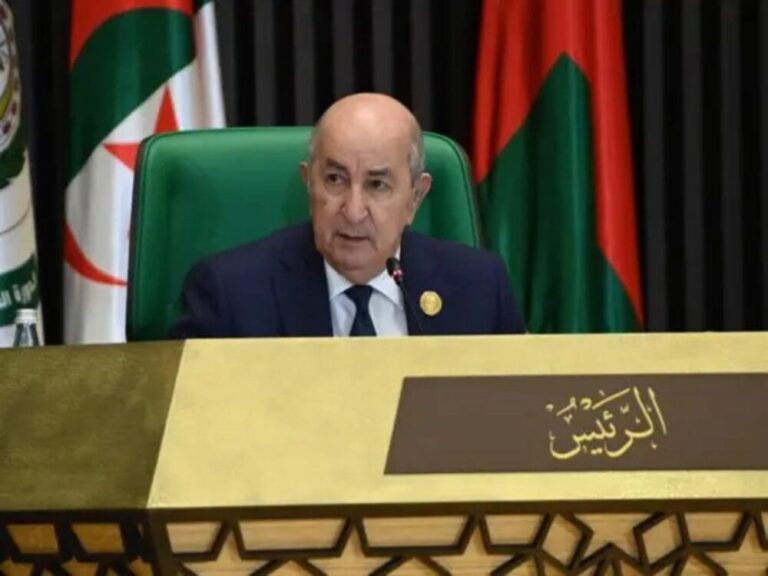
Algerian President Abdelmadjid Tebboune chaired an emergency meeting on Thursday focused on the country’s imports and exports, as alarming trade figures put mounting pressure on the government.
Held at the presidential palace, the session brought together top economic and security officials in what appears to be an attempt to reassert authority over a sector mired in dysfunction and stagnation.
The meeting comes at a critical juncture, as Algeria continues to grapple with a prolonged slump in non-hydrocarbon exports, which have hovered around $5 billion annually since 2020—a modest figure for a country of over 45 million people. In response, the government introduced new import controls in early July, requiring businesses to submit a Forecast Import Program (PPI) for the second half of 2025, pre-approved by multiple ministries. The regulation, in effect since July 9, adds further layers to an already burdensome system widely viewed as among the most restrictive in the Maghreb region.
Officially, the measure aims to curb commercial fraud, speculation on imported raw materials, and preserve foreign currency reserves. In practice, however, it reflects the state’s broader failure to foster competitive domestic production and to create an export-friendly business environment. The government’s target of $10 billion in non-hydrocarbon exports by the end of 2025 appears far-fetched in the absence of a structured industrial base, efficient logistics, or stable fiscal incentives.
Thursday’s meeting brought together Minister of Foreign Trade Kamel Rezig, Business Leaders’ Confederation (Crea) President Kamel Moula, the heads of Internal Security and Customs, the Ministers of Transport and Finance, and Presidential Chief of Staff Boualem Boualem. The participation of security services in an economic meeting, analysts say, highlights the government’s top-down, security-focused approach to an increasingly urgent economic crisis.
While neighbouring Morocco continues to expand integrated industrial zones, secure trade agreements, and develop export-oriented logistics platforms, Algeria remains hampered by rigid administrative controls, restrictive currency regulations, and a lack of coherent competitiveness strategy. With falling energy revenues and persistent reliance on oil and gas, this inertia poses a significant medium-term risk to the country’s economic stability.
No structural reforms were announced following the meeting. A presidential statement referred only to a desire for greater intersectoral coordination, offering no timeline or roadmap. The gathering mainly exposed deep-rooted dysfunction, mounting tensions between customs authorities and business operators, and the growing disconnect between official ambitions and ground realities.
MK/te/lb/as/APA