



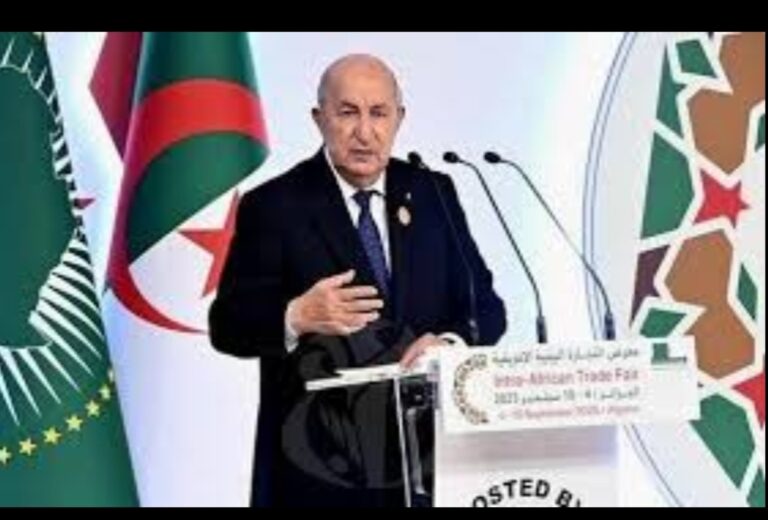
Algerian President Abdelmadjid Tebboune has promised to transform Algeria’s ports into “express routes” for landlocked African nations, with the goal of boosting trade.
The announcement was made on the sidelines of the 4th Intra-African Trade Fair in Algiers and is intended to signal a major shift in the country’s foreign policy. However, many observers see this move as a reaction to Morocco’s established Atlantic Initiative rather than a structured plan.
Morocco’s Atlantic Initiative, launched in November 2023, is already well underway. It is a long-term project that gives landlocked Sahel countries, including Mali, Niger, Burkina Faso, and Chad, access to the Atlantic Ocean. The project’s centerpiece is the Dakhla Atlantique port, a massive hub currently under construction and set to open by 2028.
The Dakhla port will be connected to the Sahel countries through a 2,200-kilometer road corridor, linking them to Morocco’s major ports in Tangier and Casablanca. This project has already gained strong regional support, with the Alliance of Sahel States (AES) reaffirming its commitment at a summit in Rabat last April. Morocco’s two decades of investments in the region have also given it a significant advantage in banking, agriculture, and infrastructure.
In contrast, Algeria’s plan lacks a clear strategy and faces several challenges. Tensions with some Sahelian countries, such as Mali, threaten to undermine diplomatic efforts. While Tebboune’s announcement may be popular at home, observers believe that without solid partnerships and concrete investments, the plan could be perceived as a move driven more by rivalry with Morocco than by a genuine commitment to continental development.
MK/ac/Sf/fss/abj/APA