



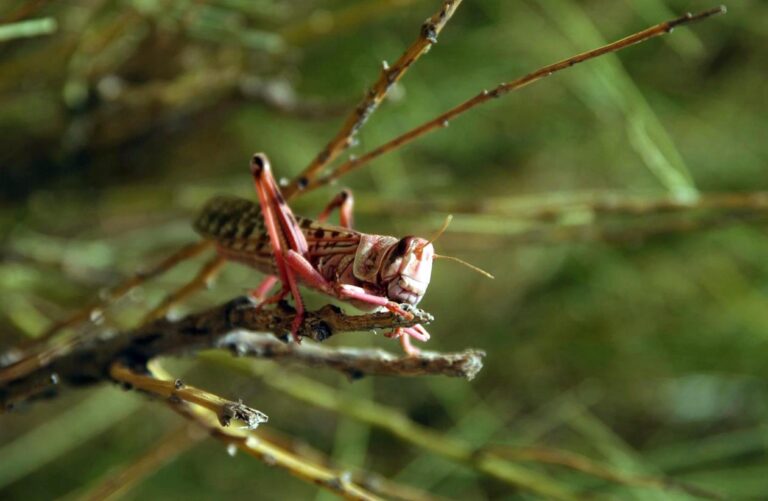
A full-to-the-hilt government mobilisation against desert locust spread in Algeria’s southwest comes as massive agricultural investments in the region face persistent structural risks.
Prime Minister Sifi Ghrieb chaired an interministerial meeting on Saturday to assess the country’s preparedness against the desert locust threat spreading across several wilayas in the southwest. Convened in line with directives from the country’s president, the session was aimed at reviewing the effectiveness of a proactive action plan put in place to contain the infestation.
Algeria says it has made a strategic shift — moving away from a reactive model focused on treating already-formed swarms toward a preventive approach built around anticipating breeding zones, particularly across the Grand South and the Sahel.
Yet that shift also lays bare a structural vulnerability. Authorities acknowledge that the effectiveness of their response depends heavily on conditions in neighbouring countries — which is why Algiers plays an active role in the Desert Locust Control Committee for the Western Region (CLCPRO), a FAO-affiliated body headquartered in the Algerian capital.
Back in 2012, Algeria treated 400,000 hectares in the south to halt a migration toward Mali and Niger.
More recently, in 2024, it supplied 30,000 litres of pesticides to Mali and Mauritania and provided 15 four-wheel-drive vehicles to Mali and Niger as part of a regional rapid-response force. According to FAO benchmarks, every million dollars invested in Sahelian surveillance can prevent an estimated $10 to $20 million in crop losses in northern Algeria.
The stakes have now grown well beyond basic pest management. The Grand South is being positioned as a strategic cereal production hub, with thousands of hectares brought under centre-pivot irrigation through what officials describe as massive capital outlays. That agricultural buildout directly amplifies exposure to locust risk.
An uncontrolled invasion could jeopardise key food security indicators and place additional strain on public finances — even as execution delays continue to dog government projects in other sectors.
The response framework rests on a strategic stockpile of over 500,000 liters of insecticides, a fleet of 12 to 15 specialised aircraft and 100 operational teams on round-the-clock standby. Algeria’s space agency is using the Alsat satellite to monitor a two-million-square-kilometre cross-border zone, scanning for moist terrain conducive to locust breeding. The emergency plan has been extended to 23 wilayas, with logistical support from the National People’s Army and the National Institute for Plant Protection.
While Algiers claims continental leadership in desert locust control, the recurring nature of these alerts is a reminder that the threat remains cyclical and largely hostage to regional and climatic dynamics.
Caught between agricultural ambitions in the Sahara and dependence on the fragile equilibrium of the Sahel, the battle against the locust remains a real-world stress test for the durability of Algeria’s development strategy.
MK/ak/lb/as/APA