





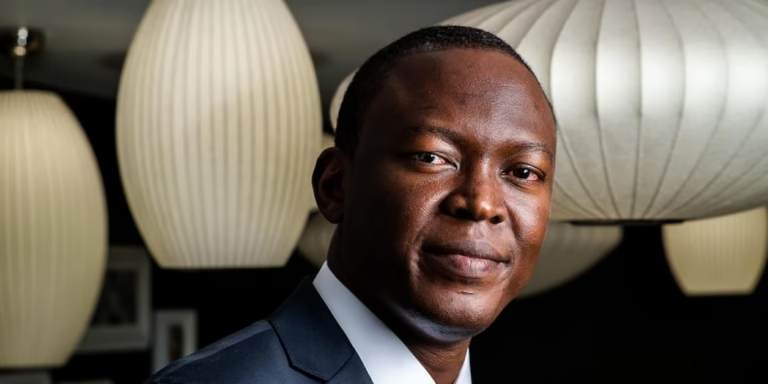
A decisive turn in two cases that have shaken Chad’s opposition. On 14 August, Succès Masra and eight former GCAP leaders saw their convictions wiped out by a presidential pardon.
After several months in detention and convictions that drew strong criticism from their lawyers and supporters, Succès Masra and the eight former GCAP leaders are set to regain their freedom. The presidential pardon granted on 14 August 2026 by President Mahamat Idriss Déby Itno brings an end to two high-profile legal cases emblematic of the recent confrontation between Chad’s government and its opposition. Here is a look back at the key stages of the two cases.
The Masra case
On 14 May 2025, intercommunal clashes broke out in Mandakao, in the Logone Occidental province, leaving 76 people dead, mostly women and children, amid recurring tensions between farmers and herders in southern Chad.
Two days later, at dawn, Dr Succès Masra was arrested at his home in N’Djamena by men in military uniform. Authorities accused him of being the main instigator of the conflict, citing an audio recording dating back to 2023 in which the opposition leader called on civilians to arm themselves.
Five days after his arrest, Masra was placed under detention. His request for provisional release was rejected on 19 June 2025 by the Indictments Chamber, despite his lawyers having petitioned the authorities as early as 19 May to challenge what they described as the arbitrary nature of his detention.
His trial opened on 7 August 2025 in N’Djamena before the Criminal Chamber of the Court of Appeal. He faced charges including incitement to hatred and revolt, forming and aiding armed groups, complicity in murder, arson and desecration of graves. He pleaded not guilty before the court. On 8 August, prosecutors sought a 25-year prison sentence.
The verdict was delivered on 9 August. The N’Djamena Criminal Court found Masra guilty and sentenced him to 20 years in prison, along with a fine of about CFA 1 billion. Several human rights organisations, including Human Rights Watch, described the trial as politically motivated. His lawyers appealed the ruling. On 21 May 2026, the Judicial Chamber of the Supreme Court upheld the original conviction.
The case of the eight former GCAP leaders
In a ruling issued on Friday, 24 April 2026, the Supreme Court declared the Group of Political Actors’ Consultation (GCAP), the main opposition coalition, null and void, effectively rendering all its activities illegal across the country. The Minister of Public Security immediately condemned the mobilisation campaign launched by the coalition ahead of a planned protest march on 2 May.
The following day, eight presidents of political parties belonging to GCAP were arrested, just hours before they were due to hold a press conference.
Placed in pre-trial detention, the eight GCAP members were charged with unlawful assembly, participation in an insurrectionary movement, rebellion and illegal possession of military-grade weapons.
Their trial was held from 5 to 6 May inside Klessoum prison. On 8 May 2026, the verdict was delivered. The Special Criminal Chamber found all eight former GCAP leaders guilty of the charges and sentenced each of them to eight years in prison and a fine of CFA 500,000. The court also ordered the confiscation of weapons seized from their homes. Their lawyers denounced the proceedings as politically motivated and announced that they would appeal.
Two cases, the same pattern
A common thread runs through both cases: the arrests came shortly after the triggering events — two days after the Mandakao violence in Masra’s case and the day after the judicial dissolution of their movement in the case of the eight GCAP leaders. Both trials were also conducted under conditions that the respective defence teams described as expedited, with both accusing the authorities of pursuing politically motivated proceedings.
On 14 August, the opposition politicians were granted a presidential pardon by President Mahamat Idriss Déby Itno. The decree states that they are to be “released as soon as the necessary arrangements are made by the Ministry of Justice in the coming hours and days.”
CA/ac/lb/as/APA