





By relaunching talks in Niger regarding the Kafra oil field and the Trans-Saharan Gas Pipeline (TSGP), Algeria is attempting to project regional energy ambitions at a time when its domestic economy is faltering and its diplomacy remains bogged down in persistent regional tensions.
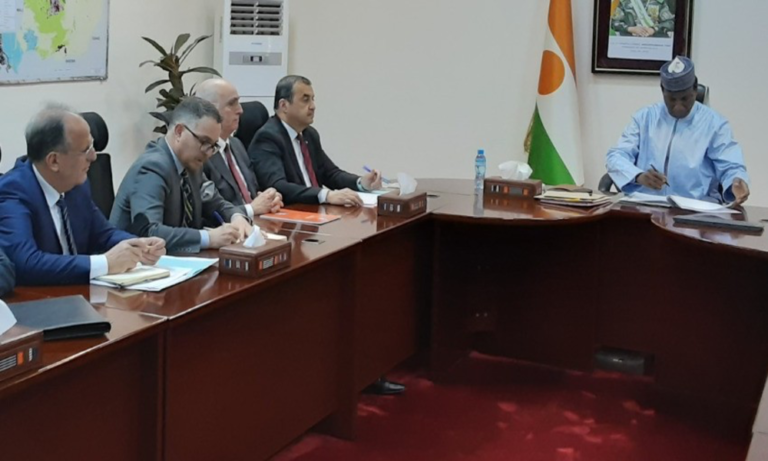
In Niamey, Algiers is seeking to revive energy projects in Niamey that it frames as “strategic,” but which increasingly resemble last-ditch gambles for a state under severe financial and diplomatic strain. The official visit to Niger by Mohamed Arkab, Minister of State for Energy, Mines, and Hydrocarbons, was ostensibly to monitor the activities of the national oil company Sonatrach, with a focus on the Kafra oil field and the Trans-Saharan Gas Pipeline. In reality, the trip highlights the urgency of an Algerian leadership desperately seeking external levers to offset its fading economic model.
Mohamed Arkab held a series of meetings with his Nigerien counterpart, Hamadou Tinni, and Prime Minister Ali Mahaman Lamine Zeine, reaffirming “Algeria’s readiness” to resume exploration at the Kafra oil block. This cautious, almost defensive phrasing stands in stark contrast to years of hammered-out announcements regarding the imminent acceleration of the project—none of which have yet materialised into actual production.
The Kafra field has become emblematic of Algerian energy diplomacy: a cycle of repeated announcements, constantly revised timelines, and perpetually delayed results. As early as September 2024, Arkab had promised a “decisive acceleration” and a fixed schedule alongside then-counterpart Sahabi Oumarou. More than a year later, Algeria is still at the stage of “resuming” suspended activities, hampered by a lack of resources, financial transparency, and regional stability.
This return to Niger unfolds against a particularly bleak Algerian economic backdrop. Despite the gas windfall, public finances remain fragile, economic diversification remains largely theoretical, and the country’s dependence on hydrocarbons has never been more glaring. The proliferation of external projects appears less as an offensive strategy and more as a “flight forward”—an attempt to mask a domestic economy bordering on asphyxiation and a state whose budgetary sustainability is causing concern even within official circles.
The TSGP project illustrates this large-scale escapism. Stretching over 4,000 kilometers and intended to link Nigeria to Algeria via Niger to supply European markets, the TSGP has been marketed for over two decades as a “major African achievement.” However, despite the optimistic rhetoric at the 2024 Gas Exporting Countries Forum summit in Algiers, the project remains largely theoretical, weighed down by colossal security, financial, and geopolitical hurdles.
In an unstable Sahel, marked by fragile political transitions and persistent security threats, the credibility of such a megaproject seems more uncertain than ever. Compounding this is Algeria’s growing diplomatic isolation, fueled by lasting friction with several neighbours and its marginalisation in various regional endeavours. In this context, the promise of becoming an African energy hub rings more like a slogan than a realistic prospect.
By ramping up visits and announcements surrounding Kafra and the TSGP, Algiers is attempting to project the image of an indispensable energy power.
Yet, behind the official communication, these projects primarily reveal a state under pressure, tempted by risky external bets to delay the reckoning of an exhausted economic model.
MK/Sf/lb/as/APA