



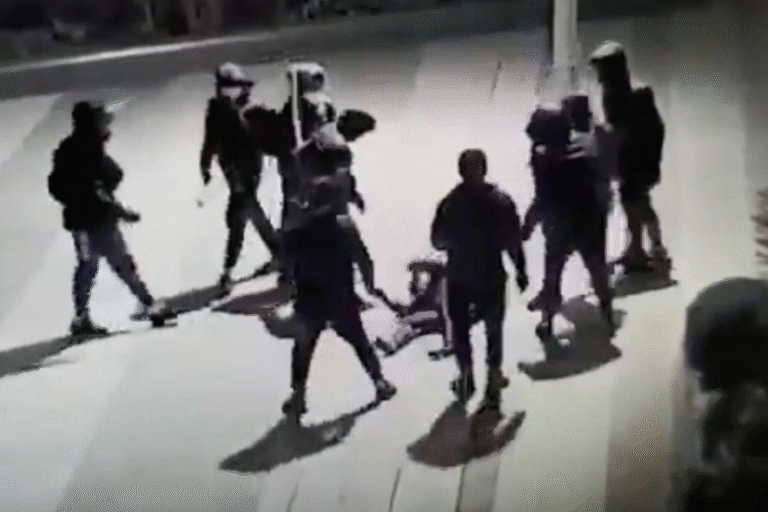
A wave of violent assaults in Algeria, filmed and widely shared on social media, has sparked public outrage and reignited debate over the shortcomings of the country’s security policies. The attacks, often carried out in broad daylight with shocking brutality, highlight deep gaps in efforts to curb rising petty crime and urban violence.
In Ain Fakroun, Oum El Bouaghi province, a 60-year-old man was viciously assaulted last Monday by two knife-wielding youths attempting to steal his bag. Seriously injured in the arm and abdomen, he underwent surgery. Although the attackers were arrested and sentenced to up to 15 years in prison, footage of the assault spread widely online, fueling a wave of national indignation.
The incident is not isolated. In Tipaza, families were attacked on a beach by a gang of youths, some still on the run. In Oran, another stabbing in the street was filmed, adding to public alarm over a phenomenon that appears to be growing in both frequency and visibility.
The authorities have tried to reassure citizens, insisting that “Algerian cities remain generally safe.” But such official statements have failed to convince, as the graphic nature of the assaults underscores what many see as the state’s inability to address root causes despite increasingly repressive laws.
Lawyer Mahdi Halfaoui estimates that “80 percent of violent crimes are linked to the consumption of psychotropic drugs,” whose use has surged across the country. Long downplayed by authorities, drug abuse now fuels theft, brawls and daily assaults. A 2020 presidential ordinance promised to “eradicate neighbourhood gangs” with prison terms of up to 20 years, but crime has continued to proliferate. The punitive approach, critics argue, has proven ineffective against a problem rooted in social crisis, mass youth unemployment and lack of opportunities.
Amid slow police response times, citizens are increasingly turning to their phones, filming assaults to alert the public and provide evidence to the courts. The practice has become commonplace, reflecting growing distrust of a security apparatus seen as unable to ensure basic protection.
These high-profile attacks are less isolated incidents than symptoms of a weakened system, exposing the contradictions of a state that speaks the language of toughness but struggles to guarantee everyday safety for its citizens.
MK/ac/sf/lb/as/APA