





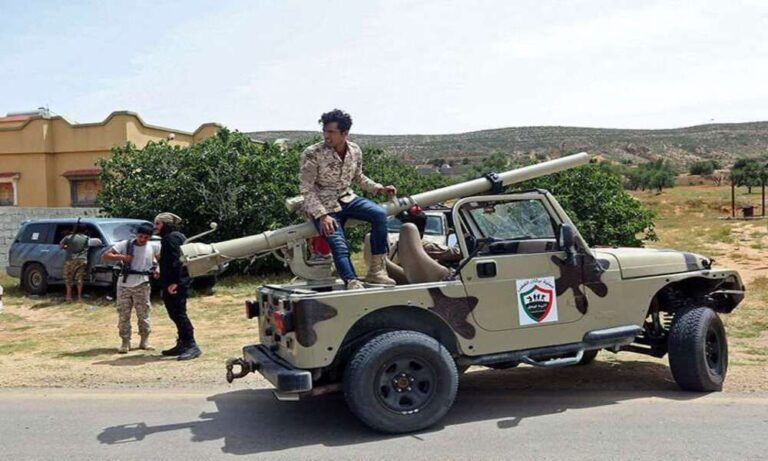
Turkey is requesting a new two-year parliamentary mandate to maintain its forces in Libya, an initiative that revives the ambiguities surrounding an engagement presented as stabilising but politically contested.
Ankara has officially asked the Turkish parliament to approve a 24-month extension of the mandate for its military forces deployed in Libya. The motion, submitted by the presidency and signed by President Recep Tayyip Erdoğan, comes amid a persistent political stalemate in Tripoli and the absence of a credible timeline for national elections, more than ten years after the fall of Muammar Gaddafi’s regime.
The document traces the evolution of the Libyan situation since 2011 and emphasises the central argument put forward by Ankara: that Libya’s stability is a determining factor for regional security.
Turkey reiterates its support for the efforts of the United Nations Security Council resolutions, and the principles of the country’s sovereignty and territorial integrity. It positions itself as an actor contributing to the preservation of the ceasefire and the advancement of political dialogue, with a view to culminating in free and fair elections.
However, this official narrative obscures a more controversial reality. The Turkish military presence, initially justified by a security cooperation agreement signed with the authorities in Tripoli, remains one of the major friction points in the Libyan dossier. It is perceived by several Libyan and regional actors as a factor of imbalance, especially since other foreign forces and mercenaries also remain involved on the ground, in repeated violation of international withdrawal commitments.
The motion warns against the risks associated with the persistent institutional deadlock and the inability of Libyan actors to agree on an electoral framework. According to Ankara, this political vacuum could destabilise the relative calm witnessed in recent months and favour a resurgence of violence. This security argument, recurrent in Turkish discourse, also serves to legitimise the duration and scale of a deployment whose exact contours remain largely opaque.
Ankara further underscores that its presence is based on bilateral agreements currently in force and on long-standing political and economic relations with Libya. Beyond security, these ties encompass broader strategic interests, particularly in the Eastern Mediterranean, where Turkey seeks to consolidate its energy and geopolitical positions in the face of shifting regional balances.
In the background, this request for an extension illustrates the contradictions of the Libyan process. Presented as a bulwark against chaos, the foreign presence also contributes to cementing the status quo, in the absence of decisive pressure for an inclusive political solution. The expected vote in the Turkish parliament thus appears less as a technical step than as a strong political signal, confirming Ankara’s long-term entanglement in the seemingly intractable Libyan issue.
MK/ak/lb/as/APA