





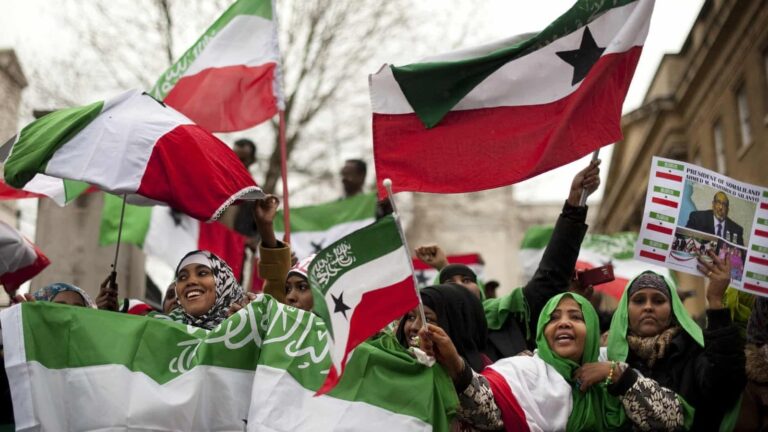
As half of the world swiftly move to condemn Israeli recognition of the sovereignty and independence of the self-proclaimed Republic of Somaliland, the debate for international acceptance of the enclave as a fully fledged state has once again come alive.
The moods could not have been more diametrically opposed in Hargeisa where Somalilanders have been jubilant, and the federal capital of Somalia in Mogadishu where protesters expressed indignation at Israel.
Somaliland, an enclave of just over 6 million people on the gulf of Aden, broke away from the rest of Somalia in 1991 months after the fall of the Siad Barre regime as the country descended into fully blown civil war which has persisted to this day.
What followed amid the chaos in Somalia was Somaliand declaring its independence and establishing its own army, currency, passport, and periodic democratic elections in the intervening decades.
Throughout all this was a spirited international campaign by its leaders for recognition as a sovereign state as Somalia deployed its diplomacy regionally and internationally against this prospect.
However, with Somalia still riven by stife thanks to a seemingly unending Islamist insurgeny by al-Shabaab, each passing decade renders Somaliland’s quest for independence a more likely prospect as the stalemate over neutralising the militants lingers on.
An editorial on a pro government website (Somaliland.com) described 26 December 2025 as the day ”when a long-running diplomatic paradox began to unwind” despite operating with all the trappings of a sovereign state such as governing its own territory, running its own institutions, maintaining internal order, and subjecting political authority to elections.
The publication bemoaned the fact that Somaliland instead of being accepted internationally for its achievements was undeservedly treated as a pariah, while inertia in war-torn Somalia was rewarded.
Israel said it was recognising the territory as an independent country based on the Abraham Accord signed during US President Donald Trump’s first term in office.
Egypt and Djibouti over the weekend joined Türkiye, Saudi Arabia, the Intergovernmental Authority on Development (IGAD) and the African Union in condemning Israel’s “unilateral” recognition of Somaliland, describing the move as unlawful and a dangerous precedent.
al-Shabaab in a statement vowed to fight what it called Israeli encroachment on Somali territory in Somaliland where the presence of its militants is minimal.
Türkiye, a strong supporter of Somalia’s government has been leading the chorus against Israeli over the move but other countries which has some ties to Somaliland have been conspicuous in their silence.
Although the Trump administration is pulicly refraining from taking a cue behind Israel’s action, sources in Washington say the situation is being closely watched by officials some of whom may be sympathetic to the Somaliland cause.
U.S. diplomatic and military delegation has been to Hargeisa, Somaliland, over the past few months exploring opportunities for deeper cooperation.
Donald Trump has been quoted as saying under his administration “everything is under study..we’ll study it. I study a lot of things and always make great decisions and they turn out to be correct.”
Bipartisan consideration for recognising Somaliland has been noticed in the U.S. Senate, perhaps given the enclave’s strategic regional importance although President Trump is reportedly yet to be convinced about its significance to US geopolitical interests in the region at this juncture.
According to Somaliland officials, about 20 other countries are waiting to recognise their territory and accord it full diplomatic status and they include the United Kingdom which has a strong presence in the capital Hargesa diplomatically and the United Arab Emirate. Although this has been brushed off as a propaganda fib, the Somaliland government claimed that those countries and other nations have been ”considering recognition” throughout the course of the year.
Enter Ethiopia, which in early 2024 reached a deal with Somaliland to recognise it in exchange for access to a slice of its coastline for security and trade. Following international pressure however, implementing this MoU has been in limbo but news of Israeli recognition will renew interest in the deal.
Before the MoU, Ethiopia maintained strong trade and diplomatic ties with Somaliland which sees Israeli recognition as a catalyst for the beginning of deeper relations with Addis Ababa and entering new ones with other nations.
Dr Hassan Khannenje, the director of the Horn International Institute for Strategic Studies, says the move could bolster Somaliland’s quest for independence but at the possible cost of changing for security infrastructure of the region and Africa as a whole.
In the days of colonial Africa, Somaliland was under the British colonial government. Somaliland politicians and activists argue that their country was not supposed to be part of Somalia, citing historical injustice and atrocities.
In his speech reacting to Israel’s decision, Somaliland President Abdirahman Mohamed Abdullahi Irro sounding conciliatory toward Somalia acknowledged the deep cultural, religious, and economic ties between their two peoples but argued that political unification in 1960 had led to nothing but historical injustices and conflict.
He said the argument for Somaliland’s independence can be strengthened by its long-term stability which meant uninterrupted peace, constitutional and democratic order since it declared itself a sovereign state 34 years ago.
Meawhile the cost of recognition is providing buffer for Israel whose strategic calculation to gain direct access to the Red Sea coastline facing Yemen where the Iranian-backed Huthi rebels have acted as the scourge of international shipping in recent years.
Somaliland News claimed with Israel, a precedent has been set, leaving other states to decide ”whether to resist it, imitate it, or adapt to it”.
”It is a deliberate political act with regional consequences, and it signals that Somaliland’s status is no longer a question to be deferred indefinitely” its editorial argued.
MG/as/APA