





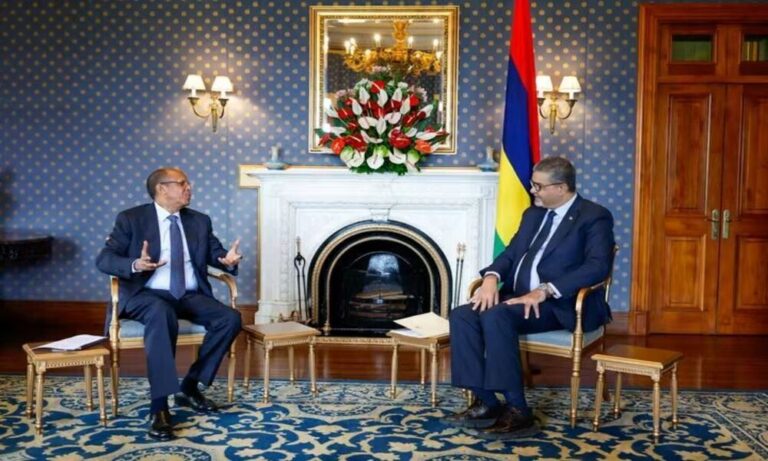
For the African Union, Mauritius’s geographic location, institutional stability, and economic openness make it a strategic link between the African continent and Asia.
This is the core message that emerged from the meeting held on Wednesday morning in Port Louis between the Chairperson of the African Union Commission, Mahmoud Ali Youssouf, and the Acting President of Mauritius, Jean Yvan Robert Hungley.
Beyond the customary formalities, the meeting highlighted the shared interests of the continental organization and the island nation.
Trade, infrastructure, logistics, supply chains, investment, and youth issues took centre stage in the discussions.
Mauritius: A Strategic Position
At a time when Africa seeks to increase its weight in global trade, Mauritius’s location in the Indian Ocean represents an asset that the African Union aims to leverage more effectively.
Developing port and maritime infrastructure, improving regional connectivity, and strengthening logistics networks should help bring African economies closer to Asian markets.
The stakes, therefore, go beyond the relationship between Mauritius and the AU; they concern Africa’s ability to better integrate into major international value chains.
This approach aligns with the goals of Agenda 2063, which identifies economic integration and
infrastructure development as key drivers of the continent’s transformation.
Mahmoud Ali Youssouf also commended Mauritius’s political stability, democratic institutions, and economic transformation. He views the Mauritian experience as a model that could inspire other African countries.
As several economies across the continent seek to attract more capital, the quality of institutions and investor confidence are becoming decisive factors.
The AU thus aims to promote an economic architecture based more firmly on reliable data and a better understanding of African realities.
Youth, the economy, and the Chagos issue
Beyond infrastructure and investment lies another key issue: demographics. Africa is experiencing rapid population growth and, in the coming decades, will be home to the world’s largest concentration of young people.
This trend represents a significant opportunity, but also a challenge if African economies fail to create sufficient jobs and prospects. For African leaders, the urgent task is to transform this demographic dynamic into an engine for growth, particularly through investment in skills, entrepreneurship, and innovation.
However, the meeting was not solely focused on the economy; the Chagos issue was also addressed. Mahmoud Ali Youssouf reaffirmed the African Union’s solidarity with Mauritius on this matter, thereby adding a geopolitical dimension to the relationship between Port Louis and the
continental organisation.
Situated on a strategic Indian Ocean maritime route, Mauritius stands at the crossroads of several key issues: international trade, maritime security, Africa-Asia relations, and sovereignty.
The meeting on October 7 outlined a partnership that goes beyond traditional diplomatic relations. For the African Union, Mauritius can serve as a gateway to Asia and help strengthen the continent’s presence in international trade.
The task now is to translate these shared interests into concrete projects involving infrastructure, trade, investment, and connectivity. For Port Louis, the challenge lies in consolidating its position at the meeting point of Africa and Asia.
TE/fss/as/APA