



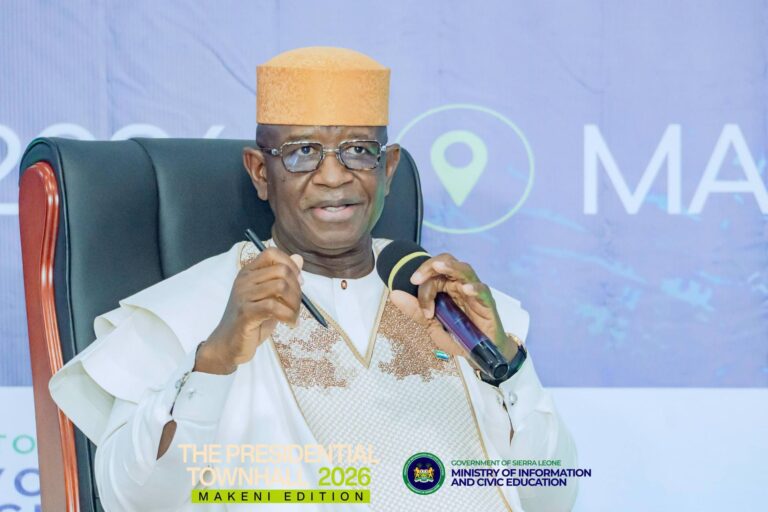
President Julius Maada Bio has issued a strong warning against the theft and vandalism of electricity infrastructure, describing the practices as major obstacles to the Government’s efforts to deliver reliable and sustainable electricity across Sierra Leone.
Speaking in Makeni on Tuesday, June 30, 2026, during the Presidential Townhall, the President called on citizens to take ownership of public electricity infrastructure by protecting it from damage and criminal activities. He stressed that vandalism of power installations and the theft of electrical equipment continue to disrupt the seamless supply of electricity, not only in Makeni but in other parts of the country.
President Bio also condemned the widespread practice of illegal electricity connections and the deliberate failure by some consumers to pay their electricity bills. He noted that while the Government continues to invest heavily in expanding access to electricity, the sustainability of the sector depends on consumers meeting their financial obligations.
The President emphasized that electricity cannot be sustained if people continue to consume power without paying for it, warning that illegal connections and meter bypasses deprive the sector of much-needed revenue required for maintenance, expansion, and improved service delivery.
Highlighting the extent of the challenge in Makeni, President Bio revealed that between 60 and 70 percent of the electricity consumed in the city is not paid for. He explained that this high rate of non-payment has placed enormous financial pressure on the Electricity Distribution and Supply Authority (EDSA), making it increasingly difficult for the utility to provide a consistent electricity supply to residents.
Despite these challenges, the President assured citizens of the Government’s unflinching commitment to transforming Sierra Leone’s energy sector through major investments in power generation and distribution infrastructure. He disclosed that plans are underway to expand the Bumbuna Hydroelectric Project, with the aim of increasing its current generation capacity of 50 megawatts to meet the country’s growing electricity demand.
President Bio also highlighted several ongoing projects that are expected to significantly strengthen the national power grid. He cited the recently commissioned 40-megawatt Newton Solar Power Plant, which began operations two weeks ago, as a major milestone in the country’s transition towards cleaner and more reliable energy.
In addition, he announced that the 108-megawatt Nant Power Plant Project, currently under construction, will soon be connected to the national grid, providing a substantial increase in electricity generation capacity. He further revealed that construction of a 10-megawatt solar power plant in Lungi is nearing completion and will further improve electricity access in the northern corridor.
The President said these investments demonstrate his Government’s determination to ensure that every region of Sierra Leone benefits from stable, affordable, and sustainable electricity. However, he emphasized that the success of these projects depends not only on Government investment but also on public cooperation through the protection of electricity infrastructure and the timely payment of electricity bills.
As Sierra Leone accelerates its energy expansion agenda, President Bio’s message in Makeni hammered a simple but crucial reality: achieving universal and reliable electricity requires a shared commitment between Government and citizens to safeguard infrastructure, eliminate power theft, and promote a culture of responsible electricity consumption.
ABJ/APA