



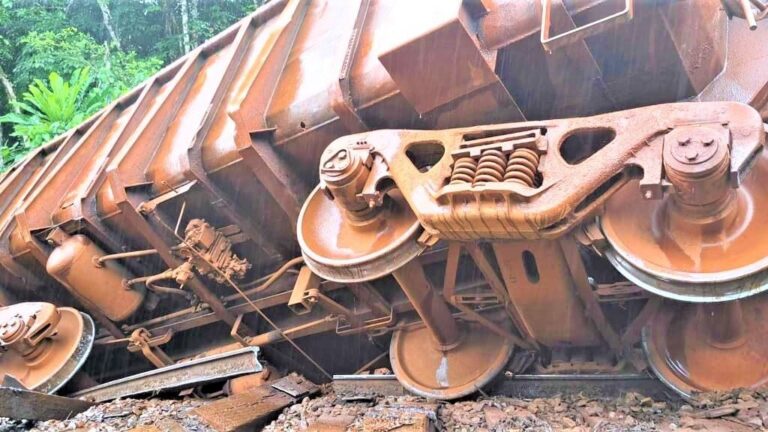
The Liberian Legislature’s deadline for the proposed National Rail Authority (NRA) Act has arrived amidst growing public concern over a recent train collision involving two ArcelorMittal Liberia (AML) locomotives.
The crash, which occurred on May 27 along the strategic Yekepa-Buchanan railway, involved two trains traveling in opposite directions and resulted in heavily derailed wagons and suspected crew injuries. More than a month later, no official accident report has been released, and the identities and conditions of the operators remain unknown. Journalists were blocked from documenting the scene, and local police have reported that AML has been uncooperative and resistant to investigation, drawing sharp criticism from local residents and rail observers.
This lack of transparency highlights a broader, historical pattern of non-compliance and oversight failures regarding Liberia’s rail infrastructure. Just six months prior, another serious AML rail accident went unreported to the Ministry of Transport, and a string of older incidents—some resulting in worker and driver fatalities—were never comprehensively disclosed to the public. Currently, AML operates massive paired locomotives pulling over one hundred wagons to maximize iron ore transport, amplifying the public’s anxiety over operational safety, emergency protocols, and the company’s apparent ability to evade independent state scrutiny.
The proposed NRA legislation seeks to resolve these systemic issues by turning President Joseph Nyuma Boakai’s October 2024 Executive Order No. 136 into permanent law. If enacted, the bill would establish an independent statutory regulator with the legal power to enforce safety standards, mandate immediate accident reporting, investigate safety failures, and oversee the transition of the rail corridor into a fair, multi-user system. Proponents of the bill argue that AML’s secrecy surrounding the May 27 crash perfectly illustrates why Liberia can no longer trust corporate concessionaires to police themselves, underscoring the urgent need for robust, independent government oversight to protect the national interest.
ABJ/APA