



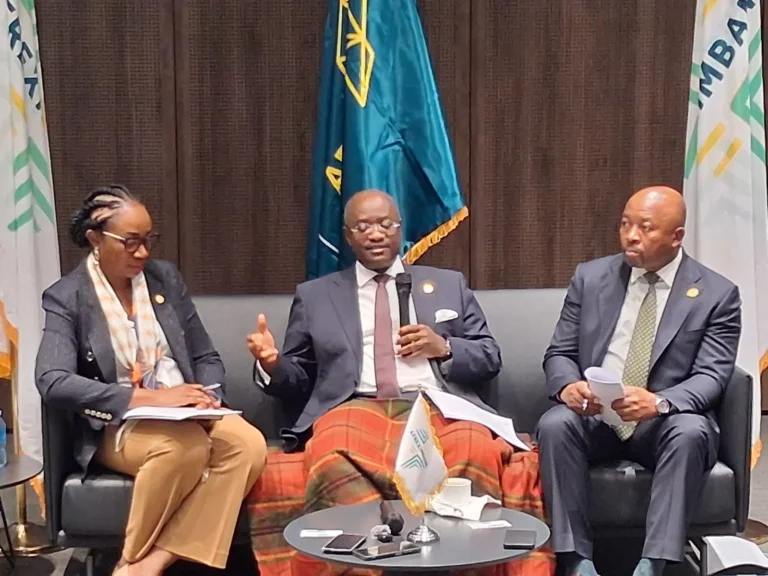
The President of the African Export-Import Bank (Afreximbank), Dr. George Elombi, has urged African journalists to reshape the continent’s narrative to boost investment and development.
Speaking at a media roundtable on Wednesday in Abuja, Elombi, who is also the Chairman of the Board of Directors, Afreximbank, stressed that prevailing international perceptions of Africa has continued to affect the continent’s ability to attract investment, raise capital and secure the expertise required for sustainable development.
According to him, international media organisations devote the overwhelming majority of their coverage of Africa to conflicts, disasters, hunger, strikes and coups, while paying little attention to the continent’s industrial and infrastructure achievements.
He said that the neglect of stories about factories, airports, refineries and other development projects reinforced what he described as a “colonised mindset” that keeps Africa dependent on external validation.
“We must change that narrative by highlighting African successes and demonstrating that excellence is an everyday reality across the continent,” he said.
Elombi criticised international credit rating agencies for what he described as arbitrary risk assessments of African institutions.
He said that African financial institutions, including Afreximbank, were often downgraded by as much as three notches simply because they operated on the continent, in spite of Africa recording lower loan default rates than many other regions.
“Don’t make those presumptions. They say we are operating in a risky environment, but year after year we demonstrate that the loans we provide are safe.
“What is the basis for describing Africa as a risky environment when less money is lost here than elsewhere?
“We must change that narrative to show that Africa is not more risky than the rest of the world, at least in terms of loan defaults.
“Eighty per cent of our balance sheet is in loans because Africa needs financing for development; but they want us to take our money out of Africa and deposit it abroad before giving us higher ratings,” he said.
The Afreximbank president expressed support for the African Union’s initiative to establish a private, professionally managed African credit rating agency.
According to him, such an institution will assess African corporations based on local economic realities rather than external prejudices.
“We must have an African rating agency run by Africans and based in Africa to rate corporates seeking finance according to our realities on the continent,” he added.
Highlighting the bank’s development interventions, Elombi cited the African Medical Centre of Excellence (AMCE) in Abuja as a flagship project aimed at reducing medical tourism by providing world-class specialised healthcare, particularly in cardiology and haematology.
He disclosed that Afreximbank has established a 75-million-dollar endowment fund to support research at the AMCE into diseases such as sickle cell disorder, which disproportionately affects people of African descent.
Elombi also highlighted the bank’s role in promoting industrialisation and self-reliance through strategic infrastructure financing.
He said Afreximbank provided 2.5 billion dollars in support for the Dangote Refinery to strengthen Africa’s energy security, reduce the high cost of petroleum imports and prove that Africa can process its own raw materials.
On regional trade integration, Elombi said that the Pan-African Payment and Settlement System (PAPSS) was now operational in 28 African countries, with adoption by their central banks and participation from no fewer than 190 commercial banks and fintech companies.
He described PAPSS as a critical platform for facilitating cross-border trade using local African currencies, thereby reducing dependence on the U.S. dollar.
Elombi urged the media to consistently amplify stories of innovation, industrialisation and economic transformation across the continent to project Africa as a competitive destination for investment, expertise and sustainable development.
GIK/APA