



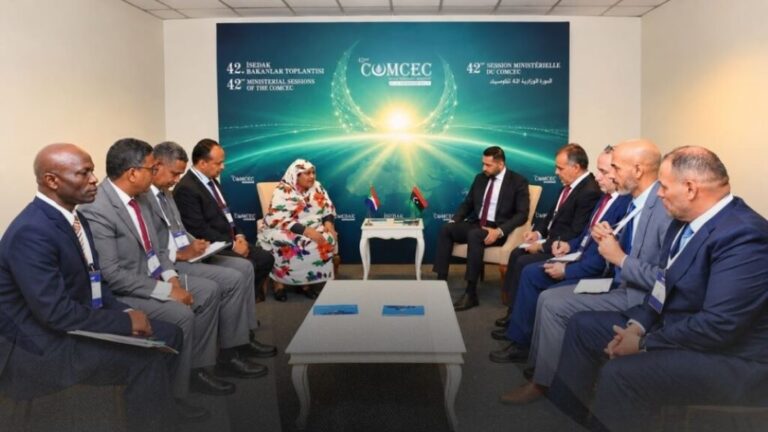
Libya intends to strengthen its economic relations with its African neighbours by updating trade agreements and improving the coordination of customs and border procedures.
Libyan Minister of Economy and Trade, Suhail Abu Shiha, held separate bilateral meetings with his counterparts from Sudan, Niger, and Chad on the sidelines of the 42nd ministerial session of the Standing Committee for Economic and Commercial Cooperation of the Organization of Islamic Cooperation (COMCEC), held in Istanbul.
The talks focused on prospects for bolstering trade relations among the four nations and enhancing the mechanisms that govern their cross-border exchanges.
Central to these talks was the revision of existing trade agreements, which are seen as needing evolution to reflect economic shifts and the new requirements of regional trade. The officials examined ways to update legal and regulatory frameworks to facilitate the movement of goods and provide greater clarity for economic operators.
The coordination of customs and border procedures was another key focus of the consultations. The objective is to reduce administrative hurdles, improve the flow of trade, and strengthen cooperation between the relevant authorities.
The talks also addressed the establishment of financial and commercial mechanisms designed to
better regulate transactions and secure cross-border operations.
According to Libya’s Government of National Unity, the four parties agreed to designate points of contact within their respective ministries.
These representatives will be tasked with following up on shared files, coordinating technical consultations, and preparing concrete proposals for the modernisation of trade agreements.
This initiative comes at a time when Libya is seeking to revitalise its economic ties within its African neighbourhood, particularly with countries in the Sahel and the Lake Chad Basin.
Relations with Niger, Chad, and Sudan are of particular interest, given the economic complementarities, logistical challenges, and supply requirements of these markets.
Beyond stated intentions, however, the realisation of this cooperation will depend on the ability of the four states to harmonise their regulations, secure trade corridors, and establish sustainable
operational mechanisms.
For Tripoli, the goal is to transform these diplomatic overtures into economic partnerships capable of supporting regional trade and strengthening its commercial foothold in Africa.
MK/AK/Sf/fss/as/APA