





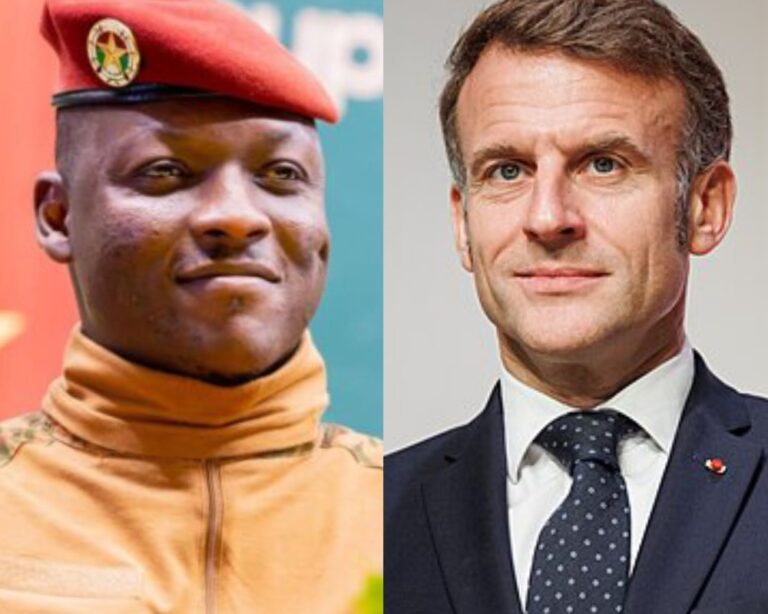
Burkina Faso has announced severing diplomatic relations with France, accusing Paris of undermining its sovereignty and supporting actions contrary to its national interests.
The move marks the culmination of several years of strained relations between the two countries since Captain Ibrahim Traoré came to power in September 2022.
The Burkinabe government said the decision takes immediate effect on Friday and represents a new stage in the steady decline of ties between Ouagadougou and Paris.
In a statement broadcast on national television, government spokesperson and Minister of Communication, Culture, Arts and Tourism, Gilbert Ouédraogo, said a review of bilateral relations had concluded that the conditions necessary for a partnership based on mutual respect, reciprocal trust, national sovereignty and non-interference no longer existed.
The government accused French authorities of engaging in what it described as “relentless activism” against Burkina Faso’s interests, pursuing “neo-colonial ambitions,” backing “subversive networks” and terrorist groups operating in Burkina Faso and the wider Sahel region, and attempting to tarnish the country’s image on the international stage.
The rupture follows years of mounting tensions between the two countries after Traoré’s rise to power in September 2022.
Since then, the Burkinabe authorities have terminated military cooperation agreements with France, overseen the withdrawal of French troops stationed in the country, suspended several French media outlets, including Radio France Internationale (RFI) and France 24, and repeatedly denounced what they regard as French interference in domestic affairs.
At the same time, Ouagadougou has strengthened ties with Russia and deepened cooperation with Mali and Niger within the framework of the Confederation of Sahel States.
The decision also comes days after a fresh diplomatic dispute with the European Union. On Monday, Foreign Minister Karamoko Jean Marie Traoré summoned the head of the EU delegation to protest a resolution adopted by the European Parliament on the human rights situation in Burkina Faso. Ouagadougou described the resolution as “unacceptable interference” based on “erroneous information” and inspired, according to the government, by “shadowy networks serving French interests.”
In a diplomatic note dated 23 June, the foreign ministry argued that the resolution reflected a “neo-colonial” approach contrary to the principles of sovereignty and non-interference enshrined in the United Nations Charter. Authorities also reiterated their position that the security crisis in the Sahel stems from NATO’s intervention in Libya in 2011, while highlighting what they described as progress made by the Defence and Security Forces (FDS) and the Volunteers for the Defence of the Homeland (VDP) in regaining territorial control.
Despite the diplomatic break, the government stressed that the decision does not affect the historical, cultural, social and human ties between the Burkinabe and French peoples. It pledged to continue ensuring the protection of French nationals residing in Burkina Faso and called on the public to act responsibly and with restraint toward them.
Ouagadougou also reaffirmed its commitment to an independent foreign policy based on diversified partnerships, stronger South-South cooperation and balanced relations with states that respect its sovereignty.
HO/ac/Sf/lb/as/APA