





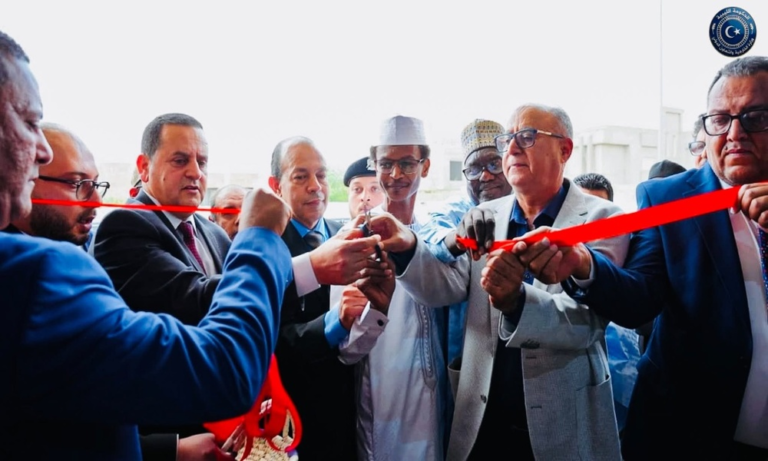
The government of Chad has officially inaugurated its new consulate general in Benghazi, a major strategic move that N’Djamena explicitly frames as a critical leap forward in political and security alignment between the two neighboring states.
In an official diplomatic dispatch, Chad’s Ministry of Foreign Affairs, African Integration, and Chadians Abroad stated that the deployment of this new consular mission in eastern Libya reflects a coordinated, bilateral determination to solidify historical ties while bringing vital state administrative services directly to the large Chadian diaspora residing in the region.
Chadian authorities emphasized that the opening is engineered to actively manage and support highly complex regional dynamics involving human mobility, cross-border commercial trade, and joint security operations. The ministry noted that the official inauguration serves as a definitive milestone toward consolidating long-standing relations of friendship, with the ultimate objective of anchoring shared development, peace, and cross-border stabilization across the fragile Sahel-North Africa corridor.
This diplomatic pivot occurs amid an accelerating wave of international engagement with eastern Libya, which has increasingly evolved into a bustling center for geopolitical coordination and security maneuvering. The formal ribbon-cutting ceremony was held in Benghazi in the presence of the Foreign Affairs Minister representing the parallel government based in eastern Libya, alongside the Deputy Secretary General of Chad’s Ministry of Foreign Affairs, who attended on behalf of Minister of State Abdallah Saber Fadoul.
The high-profile nature of the gathering underscored the strategic weight assigned to the event by regional powers. The guest list included the mayor of Benghazi, the chairman of the foreign affairs committee of the Libyan House of Representatives, and a strong contingent of civilian and military commanders. Furthermore, more than ten African, European, and Asian consuls general currently accredited in Benghazi observed the ceremony, standing alongside civil society leaders representing the Chadian and broader sub-Saharan migrant communities established in the city.
Ultimately, N’Djamena treats this calculated diplomatic expansion as a clear recognition of the pivotal role that Benghazi now plays in the balancing of regional power. The coastal city is steadily materializing as a primary nexus for the political and economic trade lines that link the Mediterranean to the deep Sahel. Consequently, Chad’s new institutional presence highlights a broader trend of African states embedding formal diplomatic assets in eastern Libya to effectively monitor, regulate, and secure the massive flows of human capital, international commerce, and counter-terrorism intelligence passing through the desert borderlands.
MK/AK/Sf/lb/abj/APA