





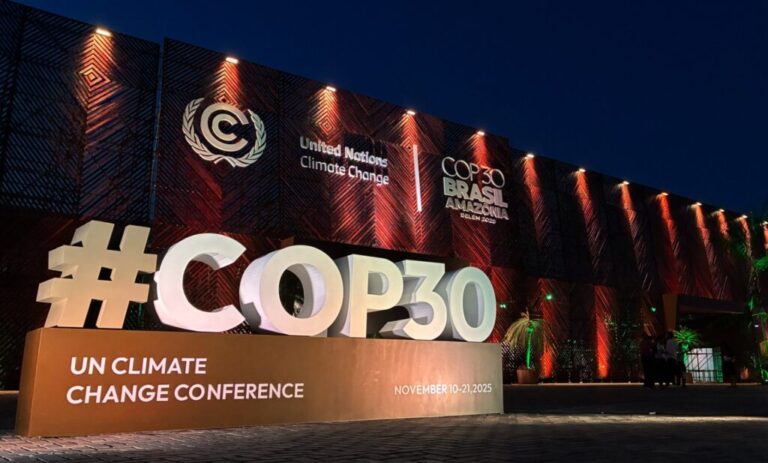
Morocco is calling for a “decade of implementation” of the Global Goal on Adaptation (GGA) and for increased, direct access to financing for African countries.
“Without funding, African countries will neither be able to operationalize the Global Goal on Adaptation (GGA) nor make use of the indicator framework, which will perpetuate the gap between action and support for adaptation,” said Bouzekri Razi, Director of Climate and Biodiversity at Morocco’s Ministry of Energy Transition and Sustainable Development, during the High-Level Dialogue on Adaptation in Baku, part of COP30 in Belém, Brazil.
For Morocco, implementation is the ultimate test of credibility.
“Our experience shows that successful adaptation relies on serious national planning and South-South cooperation,” he affirmed.
Aware of its vulnerability, Morocco has aligned its updated Nationally Determined Contribution (NDC) with the United Arab Emirates’ resilience framework, identifying actions that contribute directly to multiple global targets, particularly those related to water, food security, health, and livelihoods. Morocco also places strong emphasis on South-South cooperation, with African collaboration at the heart of its climate policy.
In this context, the African Agriculture Adaptation Initiative (AAA), launched by King Mohammed VI during COP22 in Marrakech, was highlighted as a flagship example of this approach.
Morocco welcomed the African Adaptation Initiative (AAI), described as the continent’s “main platform” to strengthen adaptation and resilience, while calling for predictable, grant-based support to embed adaptation into Africa’s sustainable development trajectory.
Despite these advances, Morocco stressed the persistence of major obstacles. Africa, Razi noted, receives less than 10% of global adaptation funding — a situation that hampers the continent’s ability to meet the 2027 and 2030 targets.
Morocco called for direct access to financing for African institutions, farmers, and cooperatives through expanded mechanisms based on grants and highly concessional terms, backed by robust adaptation indicators to ensure traceability, trust, and transparency. Achieving the GGA targets also requires effective technology transfer and capacity-building.
He further emphasised the need for indicators that are adapted, transparent, but above all flexible, non-prescriptive and non-punitive, to reflect the diversity of countries’ vulnerabilities and priorities, especially in sectors such as agriculture and water that underpin human security.
AK/sf/lb/as/APA