



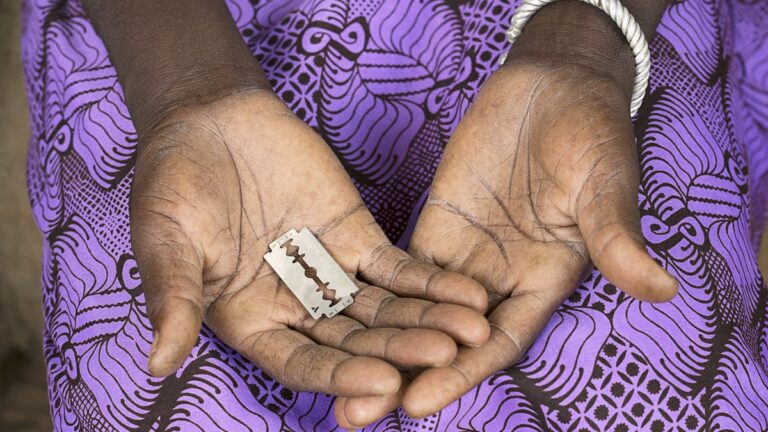
Courts are emerging as a critical frontline in the fight to end female genital mutilation (FGM), a report by Equality Now suggests.
According to the report sent to APA on Wednesday Over the past two decades, international recognition of FGM as a human rights violation has grown, alongside a shift toward criminal bans.
Globally, FGM is seen as a serious human rights violation involving the partial or complete removal of external female genitalia for non-medical reasons.
The practice is associated with severe physical and psychological problems, and stems from gender inequality.
The report which is the result of a legal research support facilitated through the Thomson Reuters Foundation’s global pro bono service, TrustLaw – reveals how women’s rights advocates and FGM survivors are increasingly using strategic litigation to strengthen implementation of laws, close legal gaps, and defend hard-won protections from rollback.
Titled ”Towards Justice: Global Challenges and Opportunities in Litigating Cases of Female Genital Mutilation”, it outlines lessons from strategic litigation in Burkina Faso, India, Kenya, Liberia, The Gambia, and the United States.
It also analyses barriers to justice in ten countries: Australia, Burkina Faso, Egypt, France, Kenya, Liberia, Sierra Leone, Uganda, the United Kingdom, and the United States.
Equality Now’s Divya Srinivasan explains, “By examining how the law works in practice, we can better understand how to harness it effectively. Our research finds that strategic litigation is one of the most powerful ways to challenge FGM by exposing gaps in protection, setting legal precedents, and driving wider reform”.
However Srinivasan observes that litigation alone is not enough and that to deliver real justice and lasting change, ”it must be backed by well-implemented, sufficiently funded enforcement of laws alongside legal systems that shield survivors from harm.”
UNICEF estimates that 230 million women and girls are impacted by FGM globally. Equality Now and its partners have collated evidence of FGM in 94 countries, but of these, only 59 have a specific law prohibiting the practice, and considerable improvement is needed to ensure better access to justice and support for survivors.
Strategic litigation can strengthen access to justice for FGM survivors
It is found that strategic criminal, civil, and constitutional litigation can strengthen state responses to FGM by exposing systemic failures and clarifying the law, setting legal precedents, and driving legal and policy reforms that have an impact beyond individual cases.
It is also held that strategic litigation can empower survivors to speak out and seek remedies.
Stakeholders hold that high-profile prosecutions raise public awareness that FGM is a socially and legally unacceptable form of violence against women and girls while other survivors are encouraged to come forward, and critical conversations are sparked within affected communities, helping drive social change that prevents future harm.
The report says ”crucially, strategic litigation can compel states to uphold their human rights obligations to protect women and girls, particularly where national protections are weak or political will has faltered”.
An illustration of a country’s obligations being clarified under constitutional and international law is the 2025 ruling by the Economic Community of West African States (ECOWAS) Court against Sierra Leone, where FGM remains widespread. The judgment specified Sierra Leone’s binding legal duties, calling on the country to criminalise FGM, adopt measures to prevent and prohibit the practice, protect those at risk, compensate survivors, investigate cases, and prosecute perpetrators.
WN/as/APA