





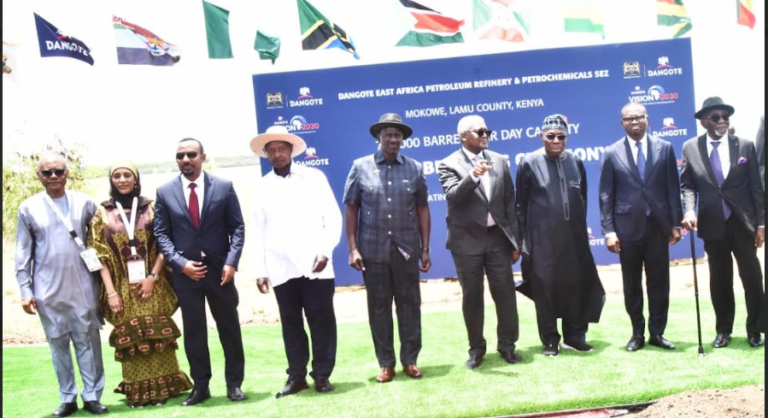
The President/Chief Executive of Dangote Industries Limited, Alhaji Aliko Dangote, joined African leaders to break ground on a $16 billion petroleum refinery and petrochemicals complex in Lamu, Kenya on Wednesday, which is designed to process 700,000 barrels of crude oil per day and serve markets across Eastern Africa.
Dangote announced that the $16 billion Dangote East Africa Petroleum Refinery & Petrochemicals in Lamu, Kenya, will be delivered within 40 months, with an ambitious local content programme that will provide jobs for qualified Lamu graduates and train more than 1,000 young people from the county.
Dangote also disclosed that 30 per cent equity in the 700,000 barrels per day refinery is being offered to East African countries, opening the landmark project to regional ownership as part of a broader strategy to strengthen energy security and retain more of Africa’s wealth within the continent.
He explained that the project will be executed at speed, assuring the gathering that the refinery would be completed within 40 months.
He said that the company had already begun mobilising equipment and technical resources for the project and would draw extensively from lessons learnt in delivering the Dangote Petroleum Refinery in Lagos.
According to him, the Kenyan refinery will be one of the fastest major projects undertaken by the Group, as the company seeks to demonstrate that African businesses can execute complex industrial projects at globally competitive scale and speed.
Dangote placed local participation at the heart of the project, announcing that qualified graduates from Lamu would be offered opportunities to work on the development, while more than 1,000 young people from the host communities would receive technical and vocational training to prepare them for jobs within the refinery and its emerging industrial ecosystem.
The Group will establish a training school to develop the technical skills required by the refinery, with emphasis on equipping local young people to participate directly in construction and subsequent operations.
Dangote said that the objective was to ensure that the economic footprint of the investment extended well beyond the refinery.
“We want young Kenyans and East Africans with skills here. We want local businesses to become suppliers. We want entrepreneurs around this project,” he said. “For me, the true measure of this project will not be the height of these towers or the number of barrels it processes.”
Instead, he said its success would also be measured by young Kenyans acquiring engineering and technical skills, local entrepreneurs building businesses around the investment and communities enjoying improved livelihoods.
“Industrialisation must have a human face. It must create dignity. It must create jobs. It must create opportunities. It must create hope,” local media reports quoted Dangote as saying.
President Ruto put the cost of the development at $16 billion, or about KSh2 trillion, describing it as a “generational undertaking” designed to serve not only Kenya but the wider Eastern African region.
The project is designed to process about 700,000 barrels of crude oil daily and generate up to 1,000 megawatts of electricity. It will also include polypropylene and base oil production as part of an integrated refining and petrochemicals complex.
Ruto reinforced the employment commitment, saying current projections envisage about 60,000 direct and indirect jobs from the development.
The President directed technical and vocational institutions and universities to prepare welders, technicians, engineers and managers for the opportunities, insisting that young people from Lamu and neighbouring communities must be given a fair opportunity to compete for the jobs.
Ruto said the construction phase alone was expected to inject more than KSh2 billion monthly in wages into the economy, with the money circulating through shops, hotels, restaurants, transport, housing and other businesses.
In another significant move towards regional economic integration, Dangote disclosed that 30 per cent of the refinery’s equity would be made available to East African countries, allowing governments in the region to participate in the ownership and future value created by the project.
He said Kenya and Rwanda had already moved quickly to take advantage of the opportunity. The ownership model fits into Dangote’s broader argument that African countries and investors should not merely host major industrial projects but should increasingly participate in their ownership and prosperity.
Dangote said the refinery had been designed as a regional asset serving Kenya, Uganda, Rwanda, Tanzania, Ethiopia, South Sudan, the Democratic Republic of Congo and other markets.
“This refinery is therefore not simply about one country. It is about a region,” he said.
The industrialist said Africa could no longer afford an economic model under which crude oil, minerals and agricultural commodities were exported while the continent imported the finished products derived from them.
“Africa cannot build lasting prosperity by exporting what it has and importing what it needs,” he said. “We must refine more of what we produce. We must process more of what we produce. We must retain more value here at home in Africa.”
GIK/APA