



Decades of civil conflict have cast a long, perilous shadow over South Sudan, leaving millions of unexploded devices scattered across the countryside and claiming over 5,000 casualties in two decades.
In settlements like Bilinyang, situated just 25 kilometers east of Juba, everyday existence was long dictated by the hidden threat of buried landmines and unexploded ordnance. Local leadership emphasizes that these remnants do far more than endanger physical safety; they immobilize entire populations, halt agricultural expansion, block trade routes, and delay the return of displaced families seeking to rebuild their lives.
To restore security and human dignity, the United Nations Mine Action Service works alongside South Sudanese authorities to systematically locate and destroy these explosive hazards. To date, international demining units have neutralized more than 1.2 million explosive devices and over 7.3 million rounds of small arms ammunition nationwide. In Bilinyang—a village haunted by a heartbreaking tragedy where an unexploded device claimed the life of a young child—the clearing operations bring profound relief, replacing constant dread with the freedom to move without fear.
These life-saving operations face severe headwinds as a broader liquidity crisis across the United Nations forces dramatic operational contractions. The UN Mine Action Service in South Sudan has seen its active clearance personnel slashed, reducing demining units from nineteen down to just eight, while specialized detection dog teams and heavy mechanical clearance equipment have been completely demobilized. Operations management warns that demining is the foundational bedrock of national recovery; without safe territory, local communities cannot farm, humanitarian assistance cannot be delivered, and national infrastructure projects remain deadlocked.
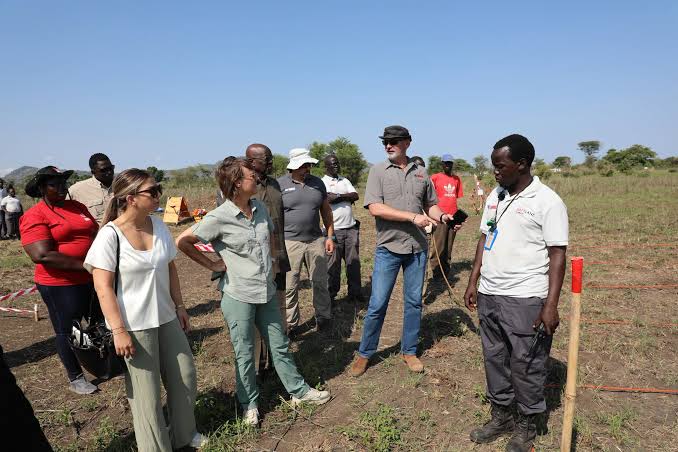
Despite these resource constraints, strategic backing from international partners remains vital. The Netherlands continues to serve as a key financial anchor for stabilization and mine clearance, providing flexible, multi-year funding directly through UN channels. During a recent field visit to witness live ordnance destruction in Bilinyang, representatives from the Dutch Ministry of Foreign Affairs highlighted the extreme conditions under which demining crews work, pointing out that securing the soil is the non-negotiable first step toward rebuilding roads, constructing schools, and laying the groundwork for long-term peace.
The tangible fruits of these clearance efforts are already visible across the broader Gondokoro region. Following the destruction of dozens of anti-tank mines, land that was once a deadly no-man’s-land has been safely reclaimed. Families returning from across the country are now erecting new homes on former minefields, transforming once-dormant ground into thriving, peaceful communities with a clear path toward a secure future.
ABJ/APA