



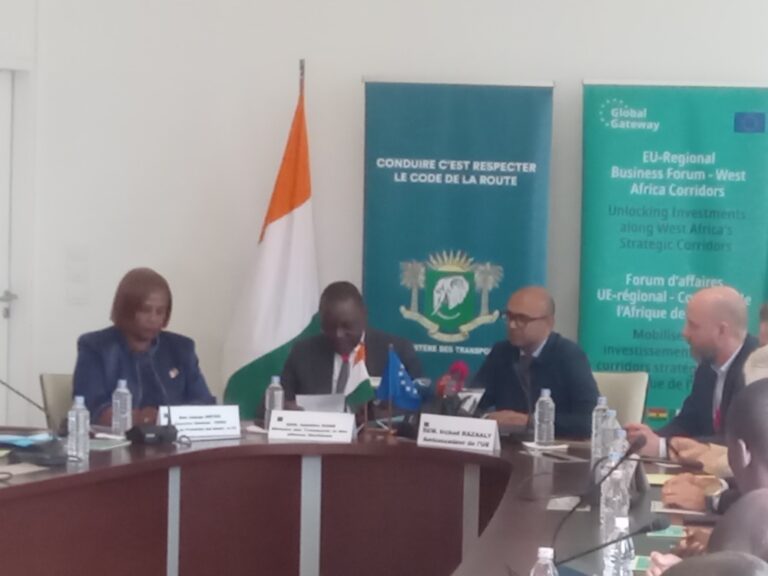
The European Union and the Ivorian government officially launched the EU-Regional Business Forum dedicated to West African corridors during a press conference held on Tuesday.
This major event, scheduled to take place from March 30 to April 1, 2026, positions Abidjan as a central site for regional integration. The forum is expected to convene more than 500 policymakers, investors, and private sector stakeholders with the primary objective of stimulating massive investments in transport and logistics along the critical Abidjan-Lagos and Abidjan-Ouagadougou corridors.
As part of the European Union’s broader “Global Gateway” strategy, this event is designed to move beyond theoretical discussion and toward tangible economic outcomes. Irchad Razaaly, the EU representative in Côte d’Ivoire, emphasized that the ultimate goal is to finalize concrete deals between businesses and financial actors to solve pressing operational urgencies. To illustrate the current logistical challenges, Mr. Razaaly noted that it presently takes a truck 12 days to travel from Lagos to Abidjan, whereas optimized corridor management could potentially reduce that journey to just four days.
The Ivorian Minister of Transport and Maritime Affairs, Amadou Kone, welcomed the initiative as a means of building sustainable partnerships and joint ventures for large-scale projects. Notable among these are the dry ports of Ferkessedougou in Côte d’Ivoire and Bobo-Dioulasso in Burkina Faso. This collaborative dynamic aligns with Côte d’Ivoire’s recently adopted National Development Program for 2026-2030, which carries a total budget of 114,838 billion CFA francs and relies on the private sector for over 70 percent of its funding.
According to Solange Amichia, Director General of CEPICI, the upcoming discussions will span several key sectors including road, rail, and maritime transport, alongside digitalization, smart mobility, and strategic infrastructure. Organized under the Global Gateway approach and the Calao program, the forum offers a unique platform for economic stakeholders across the West African region. Over the course of three days, participants will engage in B2B and B2G meetings, as well as specialized investment clinics designed to address and remove barriers to financing. By bringing together the eight UEMOA countries alongside Ghana and Nigeria, Abidjan continues to confirm its strategic role as a hub and driver of economic integration in West Africa.
AP/Sf/fss/abj/APA