





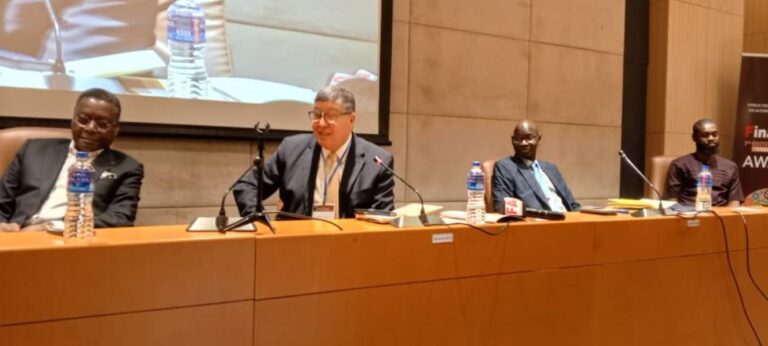
The Gambia Investment and Export Promotion Agency has set its stall out for serious collaborations with sister bodies in the West Africa sub-region to realise and maximise the gains of trade that transcend borders.
GIEPA is The Gambia’s main facilitator for investments originating from the local scene as well as ventures from beyond its borders, creating the enabling environment including tax waivers for business concerns to operate with fiscal security and stability and enjoy dependable legal cover.
It is The Gambia’s go-to agency for defining and regulating partnerships between public and private entities with a view to improving the climate for business and services for both indigenous and foreign concerns.
The agency’s managing director, Hamey B. Jawara, participating at the opening session of the Financial Afrik Awards taking place in Banjul from 22-23 January, said GIEPA was in good stead to market its investment model to interests based outside the country and encourage them to set up shop locally to enjoy business climate made attractive by government protection and value-driven incentives.
He said one of the locations for this drive fr example is the Trans-Gambia Corridor Special Economic Zone (SEZ) which is being gradually transformed into a logistic and trade hub for not only The Gambia but also for immediate neighbours Senegal, Mali and Guinea-Bissau.
The Senegambia Bridge, opened in 2019, links the Gambia’s northern and southern banks of the River Gambia and also connects northern and southern Senegal, cutting travel times by several hours, thereby minimising if not eliminating mammoth challenges to trade and other services. Jawara said through tax incentives, GIEPA is slowly turning the zone into a credibly competitive hub for manufacturing, agro-processing and packaging of goods and services for export.
The volume of traffic in the Lower River Region where the zone is located makes GIEPA’s investment facilitation imperative he said.
According to Jawara, GIEPA has been cultivating working relations with its Senegalese equivalent, Agence Nationale Pour la Promotion des Investissementset des Grand Travaux (APIX), a relation which allows both partis to share or exchange notes, synchronise their remits and facilitate crossborder investments that could enhance the business climate in both countries.
Renowned Senegalese architect and builder, Pierre Goudiaby Atepa, who is also at the event explored this cross border investment between The Gambia and its closest and much larger neighbour Senegal to maximise the benefits of business ventures. He said the two countries inextricably linked by geography, culture and history should use the much touted Africa Continental Free Trade Area (AfCFA) as a platform to demonstrate how business interconnections transcending their borders be mutually beneficial and form the basis for other countries on the continent to follow this example. It was Goudiaby’s submission that The Gambia’s suitable location in West Africa should be an advantage for business.
H-Midouche Mohammed, a former resident representative of the African Development Bank in The Gambia who moderated the opening session seemed to agree.
He said The Gambia’s modest size and its relatively small should be to its advantage as far as the parameters for development are concerned and suggested stakeholders in its business profile cash in on this to transform a country that is truly transformable through economic dynamism.
The event also includes a special awards gala on Friday to name and celebrate Africa’s 100 most outstanding shapers of the continent’s economic landscape in the past year.
These often distinguished personalities are usually chosen through what Financial Afrik Awards says is a rigorous process based on the level of impact of their visions, decisions and contributions to economic development in countries on the continent.
Since 2018, these awards have made it into the flagship calender of events for financial stakeholders and like-minded interests in Africa every year.
The theme of the Banjul sessions is anchored around public-private partnerships as a handy alternative to limiting public debt as a burden to developing countries in Africa whose promising economic growth prospects have been hamstrung by the lack of proper drive to improve business regulations.
Some of its thematic sessions are exploring PPPs as a means of funding infrastructural developments through the mobilisation of private capital for the timely realisation of socially beneficial projects without compromising fiscal stability.
WN/as/APA