



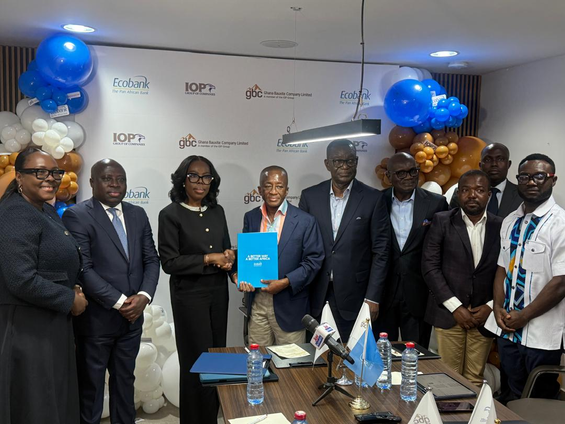
Ghana Bauxite Company Limited (GBC) has signed a US$250 million financing arrangement with Ecobank Ghana PLC to prepare and expand its Awaso mine to feed its planned alumina refinery.
This forms part of the ambition of developing an Integrated Aluminium Industry (IAI) that would move the country beyond exporting raw bauxite towards producing alumina, aluminium and higher-value manufactured products.
The GBC Director, Robert Danso Boakye, told journalists after the signing of the mandate that appoints Ecobank Ghana PLC as exclusive Mandated Arranger, on a best-efforts basis, for facilities of up to US$250 million.
According to local media reports, the signed agreement comprises a term loan for capital expenditure and a revolving credit facility for working capital
Under the agreement, Ecobank will structure the facilities, engage prospective financial institutions and manage the syndication process, leveraging its pan-African network.
Speaking at the signing, Abena Osei-Poku, MD of Ecobank Ghana, said, “Transformative projects require more than capital. They require financial expertise, the ability to bring institutions and investors together.”
Mr. Danso Boakye explained that the expansion is aimed at ensuring the mine has the ability to sustainably supply the refinery when constructed.
“This is a big mine. You cannot just start the refinery when supply is not sorted. So we need to boost production at the mine first,” he said
According to the mine’s data, bauxite exports increased from 773,213 metric tonnes in 2022 to approximately 2.07 million tonnes in 2025.
This performance reflects an improvement in mining capacity, supported in part by the introduction of surface-mining equipment and a wider programme of operational investment.
According to Mr. Danso Boakye, the refinery will require 4.5 million tonnes of bauxite to produce 1.5 million tonnes of alumina, which will in turn yield 750,000 metric tonnes of aluminium.
“If you do three metric tonnes of bauxite, you have one metric tonne of alumina. Two metric tonnes of alumina gives you one metric tonne of aluminium. And that is what you use for roofing sheets, cooking utensils, aeroplanes, all the downstream aluminium products,” he explained.
The long-term plan is a refinery with an initial 500,000 tonnes per annum in the first phase, scaling to 1.5 million tonnes.
Ofori-Poku Company Limited (OPCL), which is a member of the IOP Group, after taking over the company, has employed about three thousand more staff.
It is expected that more direct jobs will be created through the expansion and the proposed refinery.
“When we build a refinery, technical people, engineers, scientists will be employed. About 600 to 700 direct jobs will be created. That is direct that you can count. But the ancillary ones would be more,” he said
The reports recalled that for decades, Ghana’s Integrated Aluminum Industry strategy has sought to move beyond raw bauxite exports.
GIK/APA