





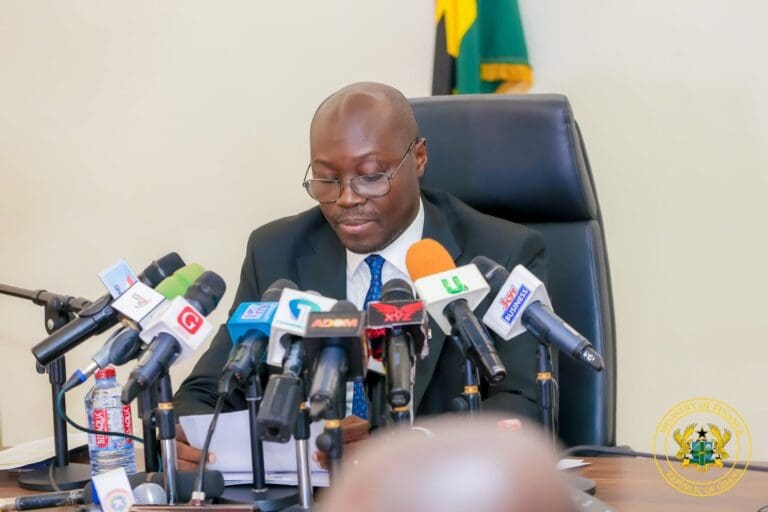
Ghana’s Ministry of Finance says that the Ghanaian government has fulfilled its latest Eurobond debt obligation with a payment of $349.52 million, bringing its total debt servicing under the restructured agreement to $1.17 billion since October 2024.
According to the statement by the Finance Ministry, the payment, processed through the Bank of Ghana and its international correspondent banks, covers scheduled coupon payments due to bondholders who participated in the country’s 2024 debt exchange programme.
This marks Ghana’s third major Eurobond settlement since restructuring approximately $13 billion in liabilities last year.
“Since the conclusion of Ghana’s Eurobond debt restructuring in October 2024, the Government of Ghana has cumulatively serviced $1,174.64 million in Eurobond debt payments,” the statement said.
The breakdown includes an initial $475.60 million payment in October 2024, followed by $349.52 million in January 2025, and today’s $349.52 million disbursement.
The statement stated that the timely settlement keeps Ghana “fully up to date” on all 2025 Eurobond obligations, with $1.41 billion due in 2026. Officials framed the consistent repayments as critical to restoring investor confidence and stabilising Ghana’s sovereign credit outlook.
“This timely payment reaffirms Ghana’s commitment to macroeconomic stability, prudent debt management, and constructive engagement with external creditors,” the statement noted.
It added that the move is expected to positively influence credit ratings, bolster foreign exchange reserves management, and reinforce trust in Ghana’s economic recovery programme.
Local media reports quoted market analysts as saying that the repayment was a pivotal step in Ghana’s post-restructuring recovery, potentially lowering future borrowing costs.
They added that the government has signalled plans to resume bilateral debt servicing from 2026, with further Eurobond coupon payments anticipated in August 2025 under the staggered repayment schedule.
The Ministry of Finance reiterated its adherence to fiscal reforms, stating that the transaction had been “incorporated into the Bank of Ghana’s reserves and liquidity management strategy” to minimise market disruptions.